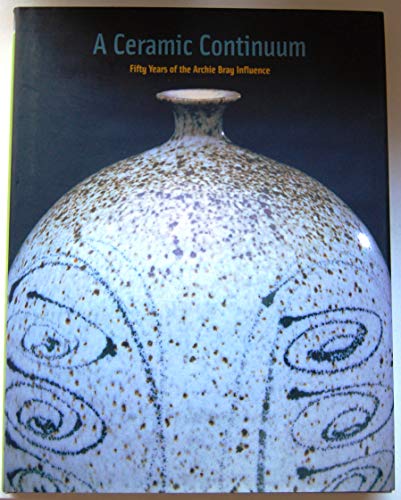
A Ceramic Continuum: Fifty Years of the Archie Bray Influence
Couldn't load pickup availability
About this book
A Ceramic Continuum: Fifty Years of the Archie Bray Influence by Failing, Patricia. hardcover edition. ISBN: 9780295981079.
For the fifty years of its existence, the Archie Bray Foundation has been a continuous, unique, and important center for the arts. Archie Bray envisioned his pottery as a place where young artists could use the brickyards clays and kilns, hone their skills, learn from each other, and develop a sensibility about the Foundations signature production ware. In 1951, Peter Voulkos and Rudy Autio became the Brays first two resident artists. By the start of the 1960s, they had accomplished a revolution in the concept of ceramic art. A series of resident directors, themselves artists, have overseen the development and expansion of the Bray Foundations programs and workshops. An ever-increasing number of young artists continue to find support and inspiration there, largely because of the three rugged individualists who gave it life and impetus. "It is a place," writes curator Peter Held, "where people come of age, finding a niche in the centuries-old continuum of the ceramic arts." "You get notorious when you start a pottery in the middle of the wilderness," Peter Meloy reflected, looking back on his own backyard pottery beginnings in Helena, Montana, in the late 1940s. Meloy went on to a career in law but remained actively connected with the arts, as did Branson Stevenson of Great Falls, a versatile artist and businessman. They became two of the three original board members of the Archie Bray Foundation for the Ceramic Arts. The other member and founder, Archie Bray, owned a brickyard that, even if at first notorious in its western isolation, became the nexus of contemporary ceramics in America. This fiftieth anniversary publication offers a history of the Archie Bray Foundation, an evaluation of its accomplishments, and a discussion of 85 works selected from more than 800 in the Bray collection. Through interviews with artists, resident directors, workshop presenters, and the late Peter Meloy, and drawing on the resources of the Foundations archives, Rick Newby and Chere Jiusto present its always lively, occasionally conflicted, and unfailingly interesting history through the voices and letters of those who knew it best. Art historian Patricia Failing considers the aesthetic and intellectual influences of the Bray experience upon artists who worked there, and on their later work. She examines the profound effects that a seminal workshop of 1952, presented by legendary potters Bernard Leach, Shoji Hamada, and Soetsu Yanagi, had upon the Brays resident potters, and subsequently on the entire concept of ceramic art in America. Art critic and writer Janet Koplos discusses the unique circumstances that gave rise to the Bray collection and gives a close reading of the 85 objects selected for the book. A Ceramic Continuum also includes a listing of all Archie Bray Foundation resident directors and artists and of workshop presenters over the years.