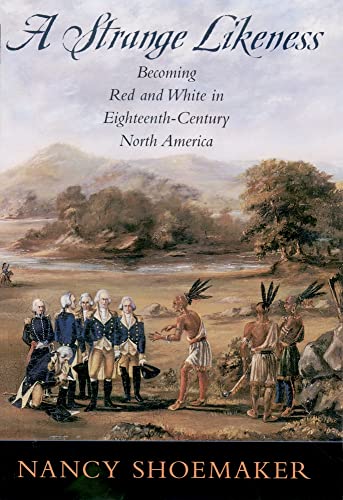
A Strange Likeness: Becoming Red and White in Eighteenth-Century North America
Couldn't load pickup availability
About this book
A Strange Likeness: Becoming Red and White in Eighteenth-Century North America by Shoemaker, Nancy. hardcover edition. ISBN: 9780195167924.
The relationship between American Indians and Europeans on Americas frontiers is typically characterized as a series of cultural conflicts and misunderstandings based on a vast gulf of difference. Nancy Shoemaker turns this notion on its head, showing that Indians and Europeans shared common beliefs about their most fundamental realities--land as national territory, government, record-keeping, international alliances, gender, and the human body. Before they even met, Europeans and Indians shared perceptions of a landscape marked by mountains and rivers, a physical world in which the sun rose and set every day, and a human body with its own distinctive shape. They also shared in their ability to make sense of it all and to invent new, abstract ideas based on the tangible and visible experiences of daily life. Focusing on eastern North America up through the end of the Seven Years War, Shoemaker closely reads incidents, letters, and recorded speeches from the Iroquois and Creek confederacies, the Cherokee Nation, and other Native groups alongside British and French sources, paying particular attention to the language used in cross-cultural conversation. Paradoxically, the more American Indians and Europeans came to know each other, the more they came to see each other as different. By the end of the 18th century, Shoemaker argues, they abandoned an initial willingness to recognize in each other a common humanity and instead developed new ideas rooted in the conviction that, by custom and perhaps even by nature, Native Americans and Europeans were peoples fundamentally at odds. In her analysis, Shoemaker reveals the 18th century roots of enduring stereotypes Indians developed about Europeans, as well as stereotypes Europeans created about Indians. This powerful and eloquent interpretation questions long-standing assumptions, revealing the strange likenesses among the inhabitants of colonial North America.