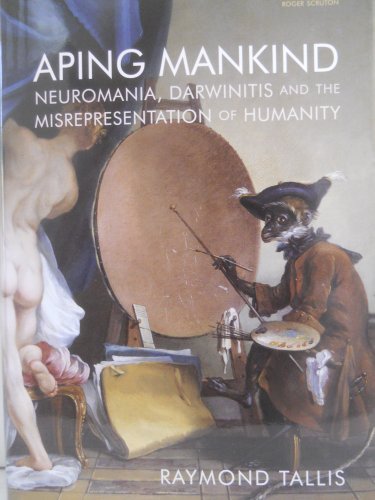
Aping Mankind: Neuromania, Darwinitis and the Misrepresentation of Humanity
Couldn't load pickup availability
About this book
Aping Mankind: Neuromania, Darwinitis and the Misrepresentation of Humanity by Tallis, Raymond. hardcover edition. ISBN: 9781844652723.
In a devastating critique Raymond Tallis exposes the exaggerated claims made for the ability of neuroscience and evolutionary theory to explain human consciousness, behaviour, culture and society. While readily acknowledging the astounding progress neuroscience has made in helping us understand how the brain works, Tallis directs his guns at neuroscience’s dark companion – "Neuromania" as he describes it – the belief that brain activity is not merely a necessary but a sufficient condition for human consciousness and that consequently our everyday behaviour can be entirely understood in neural terms. With the formidable acuity and precision of both clinician and philosopher, Tallis dismantles the idea that "we are our brains", which has given rise to a plethora of neuro-prefixed pseudo-disciplines laying claim to explain everything from art and literature to criminality and religious belief, and shows it to be confused and fallacious, and an abuse of the prestige of science, one that sidesteps a whole range of mind–body problems. The belief that human beings can be understood essentially in biological terms is a serious obstacle, argues Tallis, to clear thinking about what human beings are and what they might become. To explain everyday behaviour in Darwinian terms and to identify human consciousness with the activity of the evolved brain denies human uniqueness, and by minimising the differences between us and our nearest animal kin, misrepresents what we are, offering a grotesquely simplified and degrading account of humanity. We are, shows Tallis, infinitely more interesting and complex than we appear in the mirror of biologism. Combative, fearless and always thought-provoking, Aping Mankind is an important book, one that scientists, cultural commentators and policy-makers cannot ignore.