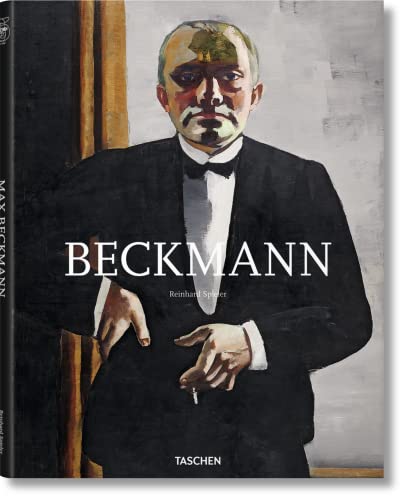
Beckmann
Couldn't load pickup availability
About this book
Beckmann by Spieler, Reinhard. hardcover edition. ISBN: 9783836532532.
Max Beckmann (1884-1950) found his central theme in the angst of 20th-century interwar experience. With a style between Expressionism and New Objectivity, later softened into more radiant naturalism, the painter and printmaker probed the strife of the human condition in portraits, self-portraits, and allegorical tableau.Beckmann’s early pictures showed the influence of Impressionism, with a leaning towards biblical, historical, and allegorical themes. Serving in the medical corps in Belgium during World War I, he was discharged after a nervous breakdown, and would return to art with anguished new strategies of distortion, angularity, and exaggerated color. In chaotic scenes of the circus, cabarets, carnivals, and candelit chambers, he emphasized the theatricality of life and seemed to foretell the doom of the interwar Weimar Republic with his cast of lurid characters, often peppered with ominous fragments of myth, biblical reference, and opaque allegory.Beckmann’s Departure is the first in a series of triptych paintings recalling the juxtaposed scenes of heaven and hell, sin and salvation typical to medieval or Renaissance altarpieces. Though the artist denied that Departure had specific meaning, it is often regarded as an emblematic response to the rise of National Soclalism, painted at the time that the Nazis fired Beckmann from his professorship at the Frankfurt Art Academy.This monograph features more than 180 of Beckmann’s from 1907 to 1950, including many of his most famous self-portraits and triptychs. Biographical essays cover his war years, the 1920s in Frankfurt, his Nazi exile years in Amsterdam, and his emigration to the United States. Bonus additional material includes photographs on which many of his paintings are based, several exhibition shots, and images from other artists as Pablo Picasso, Eugène Delacroix, Max Ernst, and Edvard Munch that visualize Beckmann’s inspirations and context.