
HomePolitics & Social Sciences BooksBetty Friedan and the Making of "The Feminine Mystique": The American Left, the Cold War, and Modern Feminism (Culture, Politics and the Cold War)
Skip to product information
1 of 1

Betty Friedan and the Making of "The Feminine Mystique": The American Left, the Cold War, and Modern Feminism (Culture, Politics and the Cold War)

paperbackSeptember 27, 2000
Regular price $33.99 USD
Regular price Sale price $33.99 USD
Sale Sold out
Shipping calculated at checkout.
Secure Checkout
Quality Guaranteed
New In Stock
ISBN-13: 9781558492769 ISBN-10: 1558492763
Publisher
University of Massachusetts Press
Binding
paperback
Published
September 27, 2000
Weight
1.3 lbs
Dimensions
23.70×2.70×15.80 cm

About this book

Betty Friedan and the Making of "The Feminine Mystique": The American Left, the Cold War, and Modern Feminism (Culture, Politics and the Cold War) by Horowitz, Daniel. paperback edition. ISBN: 9781558492769.
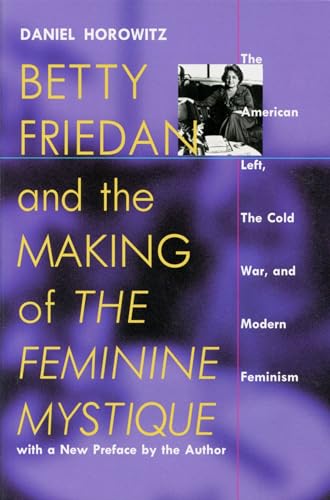
Ever since the 1963 publication of her landmark book, The Feminine Mystique, Betty Friedan has insisted that her commitment to womens rights grew out of her experiences as an alienated suburban housewife. Yet as Daniel Horowitz persuasively demonstrates in this illuminating and provocative biography, the roots of Friedans feminism run much deeper than she has led us to believe. Drawing on an impressive body of new research―including Friedans own papers―Horowitz traces the development of Friedans feminist outlook from her childhood in Peoria, Illinois, through her wartime years at Smith College and Berkeley, to her decade-long career as a writer for two of the periods most radical labor journals, the Federated Press and the United Electrical Workers UE News. He further shows that even after she married and began to raise a family, Friedan continued during the 1950s to write and work on behalf of a wide range of progressive social causes. By resituating Friedan within a broader cultural context, and by offering a fresh reading of The Feminine Mystique against that background, Horowitz not only overturns conventional ideas about "second wave" feminism but also reveals long submerged links to its past.