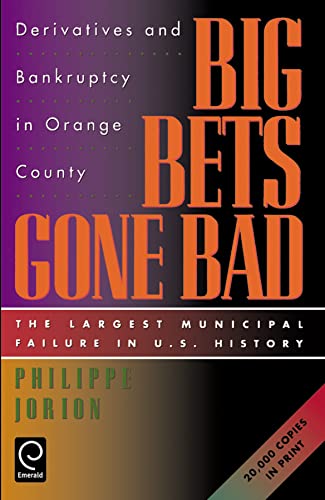
Big Bets Gone Bad: Derivatives and Bankruptcy in Orange County. The Largest Municipal Failure in U.S. History
Couldn't load pickup availability
About this book
Big Bets Gone Bad: Derivatives and Bankruptcy in Orange County. The Largest Municipal Failure in U.S. History by Jorion Ph.D., Philippe. paperback edition. ISBN: 9780123903600.
How can a municipal investment pool, which is supposed to be safe, lose billions of dollars? What are derivatives and how did they contribute to this tragedy? In December 1994, Orange County became the largest municipality in U.S. history to become bankrupt. By borrowing heavily and placing the wrong bets, Orange County Treasurer Robert Citron lost $1.7 billion of Orange Countys $7.4 billion investment portfolio. "Big Bets Gone Bad: Derivatives and Bankruptcy in Orange County" is the first detailed description of the Orange County bankruptcy. Author Philippe Jorion, the only professor in Orange County who teaches and researches derivatives, is uniquely placed to understand the technical details of the portfolio and climate in the Orange County municipal government that encouraged the decisions that led to the bankruptcy. "Big Bets Gone Bad" provides an introduction to the U.S. bond market and details Federal Reserve Chairman Greenspans efforts to tighten credit. Its description of the $35 trillion derivatives market makes the losses of Barings Bank, Kashima Oil, West Virginia, and Metallgesellschaft more understandable. "Big Bets Gone Bad" explains what everyone should know about tax monies and public investments. Because nobody likes to lose $1.7 billion.