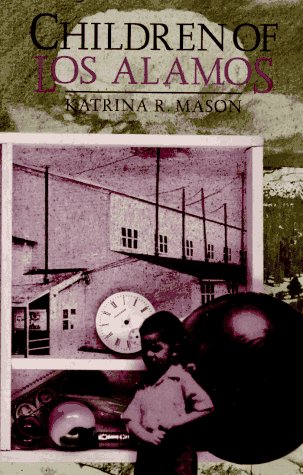

Children of Los Alamos: An Oral History of the Town Where the Atomic Age Began (Twayne's Oral History Series)
Couldn't load pickup availability
About this book
Children of Los Alamos: An Oral History of the Town Where the Atomic Age Began (Twayne's Oral History Series) by Mason, Katrina R.. paperback edition. ISBN: 9780805791396.
Katrina R. Mason has interviewed a wide range of people who spent all or parts of their childhoods in Los Alamos - from its muddy beginnings in 1943, when residents officially lived at P.O. Box 1663, to the late 1950s, after the laboratory had come under the auspices of the Atomic Energy Commission - to create this engaging and provocative portrait of a place that has come to epitomize both the scientific advances and the moral ambiguities of this century. Collectively the wartime children of Los Alamos - the children of scientists, of machinists and technicians from around the country, of construction workers from Texas and Oklahoma, and of Spanish Americans - constituted a microcosm of the United States. Mason identifies three elements common to their childhood recollections: a magnetic attraction to the land; a sense of security, that children always felt safe there; and multiculturalism. Almost all the children interviewed attribute their interest in other cultures and ability to get along with all kinds of people to their experience at Los Alamos. Some note that in important ways Los Alamos was an unusually stratified community, but most agree that scholastic achievement, not family background, determined ones place in the childrens social strata. Mason gives readers a glimpse of what it was like to be the child of such luminous fathers as J. Robert Oppenheimer, Enrico Fermi, Edward Teller, Hans Bethe, and Kenneth Bainbridge at such an intense moment in American history. Her interviews also show what it was like to live in such a community when you were the child of a Spanish-American laborer or a machinist whod brought his family over from a neighboring state. She explores howthe children have dealt with their often conflicting feelings about their parents involvement in the creation of such a destructive weapon. Masons volume illuminates these personal and often very emotional dimensions of a fascinating historical era, and as such should prove inv