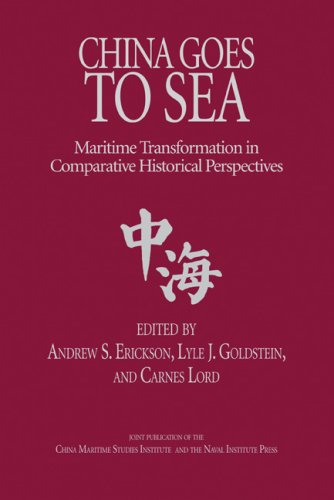
China Goes to Sea: Maritime Transformation in Comparative Historical Perspective
Couldn't load pickup availability
About this book
China Goes to Sea: Maritime Transformation in Comparative Historical Perspective by Erickson, Andrew Sven. hardcover edition. ISBN: 9781591142423.
In modern history, China has been primarily a land power, dominating smaller states along its massive continental flanks. But Chinas turn toward the sea is now very much a reality, as evident in its stunning rise in global shipbuilding markets, its vast and expanding merchant marine, the wide offshore reach of its energy and minerals exploration companies, its growing fishing fleet, and indeed its increasingly modern navy. Yet, for all these achievements, there is still profound skepticism regarding Chinas potential as a genuine maritime power. Beijing must still import the most vital subcomponents for its shipyards, maritime governance remains severely bureaucratically challenged, and the navy evinces, at least as of yet, little enthusiasm for significant blue water power projection capabilities. This volume provides a truly comprehensive assessment of prospects for Chinas maritime development by situating these important geostrategic phenomena within a larger world historical context. Too many works on China view the nation in isolation. To avoid this problem, the authors, all authorities on their respective historical eras, examine cases of attempted maritime transformation through the ages, from the Persian Empire to the Soviet Union, and determine the reasons for success or failure. Their work updates other books written on the subject that have been overtaken by Chinas rapid strategic and technological change. Readers will especially appreciate the books detailed maps and forward-looking analytical framework for understanding the future of Asian maritime power. China is hardly the only land power in history to attempt transformation by fostering sea power. Many continental powers have elected or been impelled to transform themselves into significant maritime powers in order to safeguard their strategic position or advance their interests. Of course, Chinas history and culture are to some extent exceptional, but building intellectual fences actually hinders the effort to understand Chinas current development trajectory. Without underestimating the enduring pull of Chinas past as it relates to threats to the countrys internal stability and its landward borders, this comparative study provides reason to believe that China has turned the corner on a genuine maritime transformation. If that proves indeed to be the case, it would be a remarkable if not singular event in the history of the last two millennia. This is the third book in the series "Studies in Chinese Maritime Development" published jointly by the China Maritime Studies Institute and the Naval Institute Press.