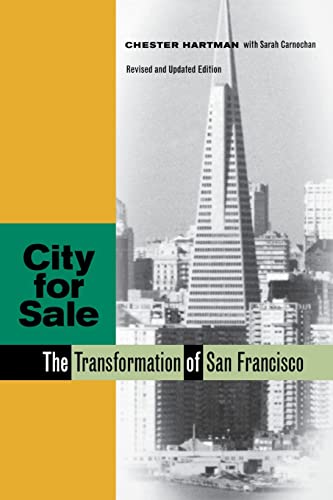

City for Sale: The Transformation of San Francisco, Revised and Updated Edition
Couldn't load pickup availability
About this book
City for Sale: The Transformation of San Francisco, Revised and Updated Edition by Hartman, Chester. paperback edition. ISBN: 9780520086050.
San Francisco is perhaps the most exhilarating of all American cities--its beauty, cultural and political avant-gardism, and history are legendary, while its idiosyncrasies make front-page news. In this revised edition of his highly regarded study of San Franciscos economic and political development since the mid-1950s, Chester Hartman gives a detailed account of how the city has been transformed by the expansion--outward and upward--of its downtown. His story is fueled by a wide range of players and an astonishing array of events, from police storming the International Hotel to citizens forcing the midair termination of a freeway. Throughout, Hartman raises a troubling question: can San Franciscos unique qualities survive the changes that have altered the citys skyline, neighborhoods, and economy? Hartman was directly involved in many of the events he chronicles and thus had access to sources that might otherwise have been unavailable. A former activist with the National Housing Law Project, San Franciscans for Affordable Housing, and other neighborhood organizations, he explains how corporate San Francisco obtained the necessary cooperation of city and federal governments in undertaking massive redevelopment. He illustrates the rationale that produced BART, a subway system that serves upper-income suburbs but few of the citys poor neighborhoods, and cites the environmental effects of unrestrained highrise development, such as powerful wind tunnels and lack of sunshine. In describing the struggle to keep housing affordable in San Francisco and the seemingly intractable problem of homelessness, Hartman reveals the human face of the citys economic transformation.