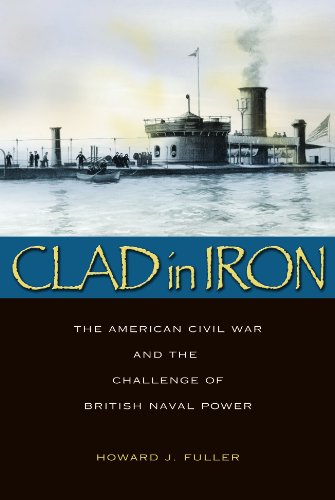
Clad in Iron: The American Civil War and the Challenge of British Naval Power
Couldn't load pickup availability
About this book
Clad in Iron: The American Civil War and the Challenge of British Naval Power by Fuller, Howard J.. paperback edition. ISBN: 9781591142973.
The relatively unknown Cold War of the American Civil War was a nevertheless crucial aspect of the survival, or not, of the United States in the mid 19th-century. Foreign intervention--explicitly in the form of British naval power--represented a far more serious threat to the success of the Union blockade, the safety of Yankee merchant shipping worldwide, and Union combined operations against the South than the Confederate States Navy. Whether or not the North or South would be clad in iron thus depended on the ability of superior Union ironclads to deter the majority of mid-Victorian British leaders, otherwise tempted by their desire to see the American experiment in democratic class-structures and popular government finally fail. Discussions of open European involvement in the Civil War were pointless as long as the coastline of the United States was virtually impregnable. The most famous warship of the American Civil War, the USS Monitor, was the front-line weapon in a grand strategic initiative established by the U.S. Government (the White House, Congress and the Navy Department) as a means of insuring the ultimate defeat of the Southern Confederacy through not only the blockade but isolation from possible foreign aid and intervention. Union ironclads were designed, approved and constructed for the specific purpose, first and last, of deterring and/or destroying the great broadside-ironclads being fashioned by European powers--especially Great Britain. As such, this work addresses many persistent misconceptions of what the monitors were for, and why they failed in other roles associated with naval operations of the Civil War (such as the repulse at Charleston, 7 April, 1863). Monitors were ironclad--not fort--killers. Their ultimate success is to be measured not in terms of spearheading attacks on fortified Southern ports, but in the quieter, much more profound, strategic deterrence of Lord Palmerstons ministry in London, and the British Royal Navy. Combining extensive archival research on both sides of the Atlantic, this work offers an in-depth look at how the Union Navy achieved its greatest grand-strategic victory in the American Civil War. Through a combination of high-tech machines armed with monster guns, intensive coastal fortifications and a new fleet of high-speed Union commerce raiders, the North was able to turn the humiliation of the Trent Affair of late 1861 into a sobering challenge to British naval power and imperial defense worldwide.