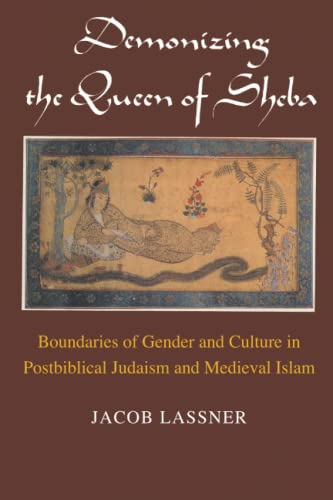

Demonizing the Queen of Sheba: Boundaries of Gender and Culture in Postbiblical Judaism and Medieval Islam (Chicago Studies in the History of Judaism)
Couldn't load pickup availability
About this book
Demonizing the Queen of Sheba: Boundaries of Gender and Culture in Postbiblical Judaism and Medieval Islam (Chicago Studies in the History of Judaism) by Lassner, Jacob. paperback edition. ISBN: 9780226469157.
Over the centuries, Jewish and Muslim writers transformed the biblical Queen of Sheba from a clever, politically astute sovereign to a demonic force threatening the boundaries of gender. In this book, Jacob Lassner shows how successive retellings of the biblical story reveal anxieties about gender and illuminate the processes of cultural transmission. The Bible presents the Queen of Shebas encounter with King Solomon as a diplomatic mission: the queen comes "to test him with hard questions," all of which he answers to her satisfaction; she then praises him and, after an exchange of gifts, returns to her own land. By the Middle Ages, Lassner demonstrates, the focus of the queens visit had shifted from international to sexual politics. The queen was now portrayed as acting in open defiance of natures equilibrium and Gods design. In these retellings, the authors humbled the queen and thereby restored the world to its proper condition. Lassner also examines the Islamization of Jewish themes, using the dramatic accounts of Solomon and his female antagonist as a test case of how Jewish lore penetrated the literary imagination of Muslims. Demonizing the Queen of Sheba thus addresses not only specialists in Jewish and Islamic studies, but also those concerned with issues of cultural transmission and the role of gender in history.