
Drifting Toward the Southeast: The Story of Five Japanese Castaways : A Complete Translation of Hyoson Kiryaku, As Told to the Court of Lord Yamauchi of Tosa in 1852 by John manjiro
Couldn't load pickup availability
About this book
Drifting Toward the Southeast: The Story of Five Japanese Castaways : A Complete Translation of Hyoson Kiryaku, As Told to the Court of Lord Yamauchi of Tosa in 1852 by John manjiro by Shoryo, Kawada. paperback edition. ISBN: 9780932027566.
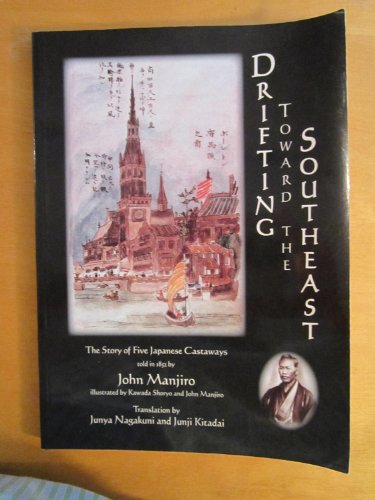
Drifting Toward the Southeast is the first complete English language edition of Hyoson Kiryakuthe official, autobiographical account of John Manjiros historic voyage to the United States as told to the officials of the Shogunate in 1852. This important historical account was hand-recorded in four brush-written volumes by samurai artist and scholar Kawada Shoryo following Manjiros nine-month interrogation by Shogun Tokugawas officials. It was prohibited from public view for many years by the Shoguns isolation law. Spinners English edition, Drifting Toward the Southeast, will showcase high-quality color reproductions of the masterful watercolor paintings by the artist Shoryo, the delicate illustrations by Manjiro himself, and the detailed maps that complete the original document. John Manjiro was the 14-year-old Japanese boy out fishing with four companions when they were shipwrecked and rescued by an American whaling ship from New Bedford, Massachusetts in 1841. Captain William Whitfield of the ship John James Howland grew fond the young castaway and invited him to his home in Fairhaven, Massaschusetts where Manjiro was given a formal education in English, mathematics and navigation. He later became mate on a whaling ship and circumnavigated the globe. Longing for Japan, he eventually joined the California Gold Rush and earned enough money for his return to his homeland. Drifting Toward the Southeast reveals Manjiros accurate memory in depicting the castaways adventures. Largely ignored in America, but legendary in Japan, Manjiro was the first known Japanese visitor to the United States who was allowed to return to Japan without facing harsh punishment for breaking the isolation law. This original account was completed just nine months before Commodore Matthew Perrys "Black Ships" armada strong-armed Japan into a peace treaty, and became coveted reading of daimyos and samurai leaders. As a result, numerous hand-written copies of Hyoson Kiryaku circulated, and the castaways story spread by word of mouth. It caught the imagination of common people who were eager to know about the outside world, and it shaped their perceptions of mid-nineteenth century America. It also deeply influenced the pioneers of modernization in Japan: men like Sakamoto Ryoma, Katsu Kaishu, and Fukuzawa Yukichi. This unique translation will create valuable source mat! erial for the study of this critical period, giving readers, educators, and historians a larger framework for understanding the history of United StatesJapanese relations. Only nine copies of the Hyoson Kiryaku are known to be in existence today. Spinner Publications has drawn from several of these copies for this translation. One is in the collection of the Rosenbach Museum in Philadelphia, another was donated to the Millicent Library in Fairhaven, a third is at the Sumiyoshi Shrine in Osaka, Japan, and a fourth is kept by the Kochi Prefectural Museum of History.
