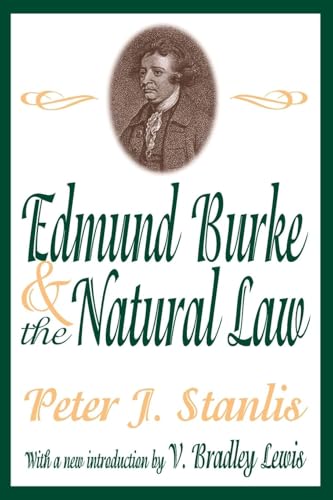
Edmund Burke and the Natural Law (The Library of Conservative Thought)
Couldn't load pickup availability
About this book
Edmund Burke and the Natural Law (The Library of Conservative Thought) by Stanlis, Peter. paperback edition. ISBN: 9780765809902.
Today the idea of natural law as the basic ingredient in moral, legal, and political thought presents a challenge not faced for almost two hundred years. On the surface, there would appear to be little room in the contemporary world for a widespread belief in natural law. The basic philosophies of the opposition--the rationalism of the philosophes, the utilitarianism of Bentham, the materialism of Marx--appear to have made prior philosophies irrelevant. Yet these newer philosophies themselves have been overtaken by disillusionment born of conflicts between "might" and "right." Many thoughtful people who were loyal to secular belief have become dissatisfied with the lack of normative principles and have turned once more to natural law. This first book-length study of Edmund Burke and his philosophy, originally published in 1958, explores this intellectual giants relationship to, and belief in, the natural law. It has long been thought that Edmund Burke was an enemy of the natural law, and was a proponent of conservative utilitarianism. Peter J. Stanlis shows that, on the contrary, Burke was one of the most eloquent and profound defenders of natural law morality and politics in Western civilization. A philosopher in the classical tradition of Aristotle and Cicero, and in the Scholastic tradition of Aquinas, Burke appealed to natural law in the political problems he encountered in American, Irish, Indian, and British affairs, and in reaction to the French Revolution. This book is as relevant today as it was when it was first published, and will be mandatory reading for students of philosophy, political science, law, and history.