
HomePolitics & Social Sciences BooksFamily Activism: Immigrant Struggles and the Politics of Noncitizenship (Latinidad: Transnational Cultures in the United States)
Skip to product information
1 of 1

Family Activism: Immigrant Struggles and the Politics of Noncitizenship (Latinidad: Transnational Cultures in the United States)

paperbackNovember 30, 2014
Regular price $41.30 USD
Regular price Sale price $41.30 USD
Sale Sold out
Shipping calculated at checkout.
Secure Checkout
Quality Guaranteed
New In Stock
ISBN-13: 9780813564562 ISBN-10: 0813564565
Publisher
Rutgers University Press
Binding
paperback
Published
November 30, 2014
Weight
0.7 lbs
Dimensions
22.90×1.50×15.20 cm

About this book

Family Activism: Immigrant Struggles and the Politics of Noncitizenship (Latinidad: Transnational Cultures in the United States) by Pallares, Amalia. paperback edition. ISBN: 9780813564562.
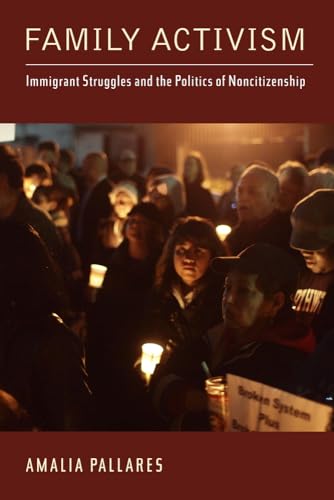
During the past ten years, legal and political changes in the United States have dramatically altered the legalization process for millions of undocumented immigrants and their families. Faced with fewer legalization options, immigrants without legal status and their supporters have organized around the concept of the family as a political subject—a political subject with its rights violated by immigration laws. Drawing upon the idea of the “impossible activism” of undocumented immigrants, Amalia Pallares argues that those without legal status defy this “impossible” context by relying on the politicization of the family to challenge justice within contemporary immigration law. The culmination of a seven-year-long ethnography of undocumented immigrants and their families in Chicago, as well as national immigrant politics,Family Activism examines the three ways in which the family has become politically significant: as a political subject, as a frame for immigrant rights activism, and as a symbol of racial subordination and resistance. By analyzing grassroots campaigns, churches and interfaith coalitions, immigrant rights movements, and immigration legislation, Pallares challenges the traditional familial idea, ultimately reframing the family as a site of political struggle and as a basis for mobilization in immigrant communities.