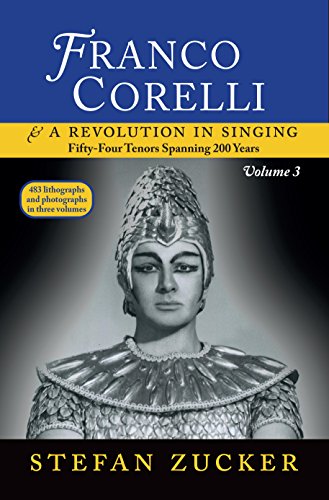
Franco Corelli and a Revolution in Singing: Fifty-four Tenors Spanning 200 Years, vol. 3
Couldn't load pickup availability
About this book
Franco Corelli and a Revolution in Singing: Fifty-four Tenors Spanning 200 Years, vol. 3 by Metropolitan Opera Archives. hardcover edition. ISBN: 9781891456015.
Corelli evaluates the singing of many tenors and says, “If an artist isn’t good he must be booed,” citing in particular Chris Merritt in I vespri Siciliani at La Scala. “Opera Fanatic” listeners confess booing, including the notorious organizer of the Scotto booings and some who booed Corelli. Bergonzi: “The difference between my singing of Bohème and of Trovatore is the degree to which I cover. Rodolfo is a lighter role, so I cover less, but Manrico is more dramatic, so I cover more.” Kraus describes his technique in detail, takes a stand against covering and excoriates Gigli, Lauri-Volpi, Caballé and Callas. The origins of lowered-larynx techniques. Jean de Reszke’s larynx-lowering. Caruso’s technique. Marcello Del Monaco’s pupils, among them Giacomini, Martinucci and Lindroos. Enrique Pina describes “floating” the larynx. Araiza describes combining larynx-lowering with mask placement. Aspiration. Olivero attacks Del Monaco’s technique. Alagna describes placing “behind the nose and between the eyes.” Like Corelli he learns technique by singing along with records and recording himself. Elena Filipova recounts how after learning larynx-lowering from Rina Del Monaco her career blossomed. Voice teacher Bill Schuman explains his technique. Also interviewed are four of his pupils: Giordani, Costello, Fabiano and Valenti. Reviews of 47 recordings of today’s top tenors: Kaufmann, Cura, Villazón, Fraccaro, Grigolo, Flórez, Brownlee, Banks, Filianoti, Cutler, Bros, Calleja and Licitra, as well as Galouzine, Beczala, Álvarez, Antonenko and Vargas. The book features many photos from various sources, among them The Metropolitan Opera Archives.