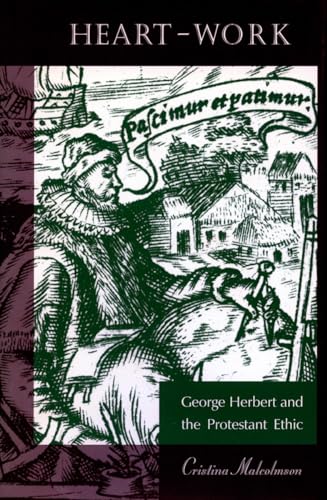
Heart-Work: George Herbert and the Protestant Ethic
Couldn't load pickup availability
About this book
Heart-Work: George Herbert and the Protestant Ethic by Malcolmson, Cristina. hardcover edition. ISBN: 9780804729888.
This book places George Herberts writing and biography within the history of social and economic change in seventeenth-century England. Drawing on the works of Max Weber, Raymond Williams, and the Protestant preachers of the period, the author argues that the doctrine of vocation is the shaping principle of The Temple and the prose manual The Country Parson, which coordinate inward devotion with outward social role like the soul with the body. This form of early modern subjectivity is shown to be significantly at odds with the system of status and yet developed in order to preserve traditional models of community. The book demonstrates that Herberts family shared his Protestant vision of "the common good," which included innovations in agriculture and mining, colonization of the Americas, and a worldwide trade nexus. William Herbert, patron of Shakespeare and head of the Protestant faction at court and in Parliament, was also George Herberts patron, and Georges involvement with this faction is offered as the explanation for his lack of patronage from an increasingly Anglo-Catholic court. His position as a country parson required the renunciation of ambition and a new ideal of the "character" of holiness but in no way decreased his dedication to the Protestant linking of religion and enterprise. The author explores the poetic coterie out of which Herberts lyrics were generated, the remarkable revisions that erased an earlier version of The Temple authorizing social mobility, and the role of class in the poetic collection as well as in modern critical accounts. Herberts use of the pastoral is considered in relation to his familys practice of gardening, which redefined economic innovation as moral reformation. The author argues that Herberts works and those of his family make visible the influence of and the resistance to the new capitalist economic system emerging in the early modern period.