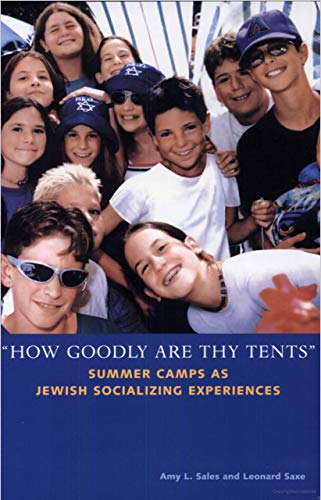

How Goodly Are Thy Tents": Summer Camps as Jewish Socializing Experiences (Brandeis Series in American Jewish History, Culture and Life)
Couldn't load pickup availability
About this book
How Goodly Are Thy Tents": Summer Camps as Jewish Socializing Experiences (Brandeis Series in American Jewish History, Culture and Life) by Sales, Amy L.. paperback edition. ISBN: 9781584653479.
In the summer of 2000, social psychologists Amy L. Sales and Leonard Saxe, along with a team of colleagues, spent several days at each of twenty Jewish summer camps located throughout the United States. They spoke to camp directors, counselors, and other staff members, and they closely observed daily life, including mealtimes, special activities, and Sabbath rituals. The result of their investigation is this enlightening book. In addition to the rich ethnographic material gleaned from their participant-observation field study, the authors offer a national census of Jewish residential camps, organizational analyzes of camps, and social psychological surveys of the attitudes and motivations of the young adults who work at camps. "How Goodly Are Thy Tents" provides a vivid snapshot of the world of Jewish summer camps. Jewish camps are often divided into two classes, those that are considered "educational camps" and others that are presumably non-educational. However, the authors believe that every Jewish camp has the potential to socialize Jewish children and young adults into k’lal Yisrael (the Jewish people). After documenting how the camp environment and the relationships formed at camp lead to social learning, the authors show how camp envelops campers and staff in a Jewish environment, exposes them to Jewish leaders and role models, and often teaches them Jewish history and Torah. Camps, they conclude, are extraordinary environments for the Jewish socialization of children. Their analysis begins with an overview of Jewish residential camps. Drawing on their national census of such camps and on their field research, they present data on the range of experiences available and on the number of Jewish children and adults who partake of these experiences. They present an insider’s look at the camps, with descriptions of the characteristics of residential camps that can make them powerful socializing environments; analysis of the varieties of formal and informal Jewish education found at camp; and insight into the religious practices, Jewish space and symbolism that abound at camp. They also present data from the perspective of the professional staff and discuss the potentially far-reaching impact on emerging adults of a summer at a Jewish residential camp. Sales and Saxe conclude by considering ways in which the field of Jewish summer camping might evolve in order to become a model of and inspiration for Jewish education and community writ large. Written for social scientists, educators, community professionals and lay leaders concerned with informal education, camping, children, ethnicity, and religion, this book will be of special interest to those interested in how culture and traditions are passed on to the next generation.