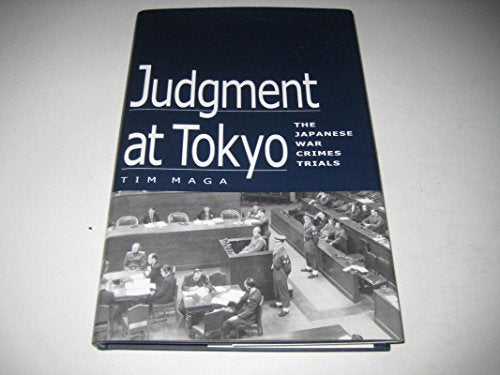
Judgment at Tokyo: The Japanese War Crimes Trials
Couldn't load pickup availability
About this book
Judgment at Tokyo: The Japanese War Crimes Trials by Maga, Timothy P.. hardcover edition. ISBN: 9780813121772.
They are plain, ordinary murderers, cried Chief Prosecutor Joseph B. Keenan, and the court at the Tokyo War Crimes Trials believed him. As a result, Japanese officers and soldiers who conducted beheading demonstrations, engaged in unethical medical experiments, or even practiced cannibalism on POWs, were found guilty of the more prosecutable charge of murder. In the years since the Japanese war crimes trials concluded, the proceedings have been colored by charges of racism, vengeance, and guilt. Tim Maga contends that despite these charges, the trials encompassed some of the most fascinating criminal cases of the twentieth century. Judgment at Tokyo is a bold reassessment of the trials, in which defendants ranged from lowly Japanese Imperial Army privates to former prime ministers. Maga shows that these were cases in which good law was practiced and that they changed the ways war crimes trials are approached today. In contrast to Nuremberg, the efforts in Tokyo, Guam, and other locations throughout the Pacific received little attention by the Western press. Once the Cold War began and America needed Pacific allies, the atrocities committed by Japanese soldiers throughout the 1930s and early 1940s were rarely mentioned. The trials were dismissed as phony justice and Japan Bashing. Since the defendants did not represent a government for which genocide was a policy pursuit, their cases were more difficult to prosecute than those of Nazi war criminals. Keenan and his compatriots adopted criminal court tactics and established precedents in the conduct of war crimes trials that still stand today. Maga reviews the context for the trials, recounts the proceedings, and concludes that they were, in fact, decent examples of American justice and fair play.