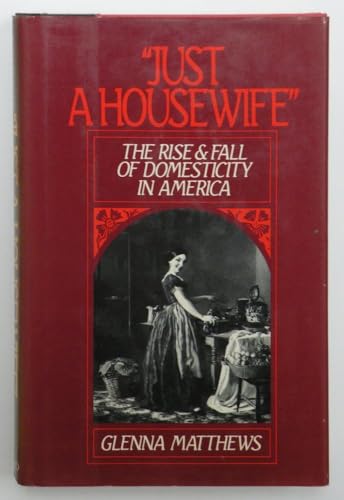
Just a Housewife": The Rise and Fall of Domesticity in America
Couldn't load pickup availability
About this book
Just a Housewife": The Rise and Fall of Domesticity in America by Matthews, Glenna. hardcover edition. ISBN: 9780195038590.
Housewives are a vast portion of humanity, yet they have received very little attention, let alone respect. Now Glenna Matthews, who spent many years as "just a housewife" before becoming a scholar of American history, sets out to redress this imbalance. What she has found will surprise many readers: While there was always greater esteem for the male world of work, in the mid-nineteenth century, she maintains there was such widespread reverence for the home that housewives had considerable self-respect. The early stages of industrialization--the invention of the stove and the sewing machine, for example--made possible a craft tradition of cooking, baking and sewing that gave women great satisfaction and a place in the world. The home had an important religious role and was seen as the center of republican virtue. There was an intermingling of private and public spheres for both men and women, and marriage was generally companionate. One hundred years later, even though women had new opportunities, most women were still occupying the role of housewife, yet much less esteem was attached to that role. On the basis of an examination of a vast array of sources, ranging from novels like Huckleberry Finn, Uncle Toms Cabin and Main Street, as well as letters, popular magazines, and cookbooks, Matthews sets out to examine what women had, and what they have lost in modern times. She argues that the culture of profesionalism of the late nineteenth century and the culture of consumption that came to fruition in the 1920s combined to kill off the "cult of domesticity" and led to what Betty Friedan identified in Feminine Mystique as "the problem that has no name"--the emptiness and devaluation of many housewives lives. This is an important, challenging book that sheds new light on a central aspect of human experience, the essential task of providing for a societys nurture and daily maintenance.