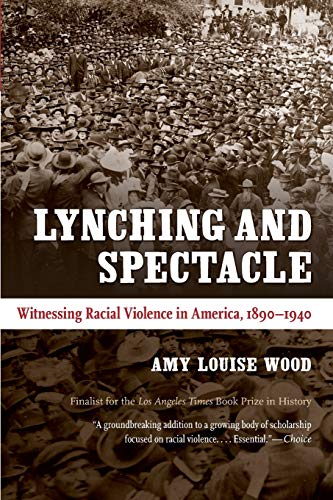

Lynching and Spectacle: Witnessing Racial Violence in America, 1890-1940 (New Directions in Southern Studies)
Couldn't load pickup availability
About this book
Lynching and Spectacle: Witnessing Racial Violence in America, 1890-1940 (New Directions in Southern Studies) by Wood, Amy Louise. paperback edition. ISBN: 9780807871973.
Lynch mobs in late nineteenth- and early twentieth-century America exacted horrifying public torture and mutilation on their victims. In Lynching and Spectacle, Amy Wood explains what it meant for white Americans to perform and witness these sadistic spectacles and how lynching played a role in establishing and affirming white supremacy. Lynching, Wood argues, overlapped with a variety of cultural practices and performances, both traditional and modern, including public executions, religious rituals, photography, and cinema, all which encouraged the horrific violence and gave it social acceptability. However, she also shows how the national dissemination of lynching images ultimately fueled the momentum of the antilynching movement and the decline of the practice. Using a wide range of sources, including photos, newspaper reports, pro- and antilynching pamphlets, early films, and local city and church records, Wood reconfigures our understanding of lynching’s relationship to modern life. Wood expounds on the critical role lynching spectacles played in establishing and affirming white supremacy at the turn of the century, particularly in towns and cities experiencing great social instability and change. She also shows how the national dissemination of lynching images fueled the momentum of the antilynching movement and ultimately led to the decline of lynching. By examining lynching spectacles alongside both traditional and modern practices and within both local and national contexts, Wood reconfigures our understanding of lynching’s relationship to modern life.