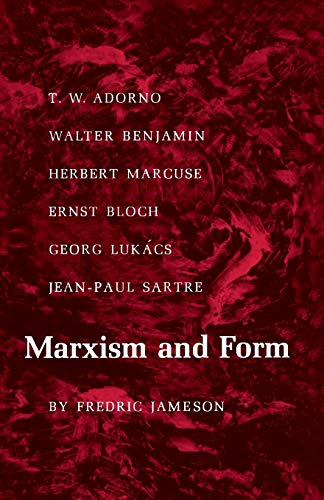

Marxism and Form: 20th-Century Dialectical Theories of Literature
Couldn't load pickup availability
About this book
Marxism and Form: 20th-Century Dialectical Theories of Literature by Jameson, Fredric. paperback edition. ISBN: 9780691013114.
For more than thirty years, Fredric Jameson has been one of the most productive, wide-ranging, and distinctive literary theorists in the United States and the Anglophone world. Marxism and Form provided a pioneering account of the work of the major European Marxist theorists--T. W. Adorno, Walter Benjamin, Herbert Marcuse, Ernst Bloch, Georg Lukács, and Jean-Paul Sartre--work that was, at the time, largely neglected in the English-speaking world. Through penetrating readings of each theorist, Jameson developed a critical mode of engagement that has had tremendous in.uence. He provided a framework for analyzing the connection between art and the historical circumstances of its making--in particular, how cultural artifacts distort, repress, or transform their circumstances through the abstractions of aesthetic form. Jamesons presentation of the critical thought of this Hegelian Marxism provided a stark alternative to the Anglo-American tradition of empiricism and humanism. It would later provide a compelling alternative to poststructuralism and deconstruction as they became dominant methodologies in aesthetic criticism. One year after Marxism and Form, Princeton published Jamesons The Prison-House of Language (1972), which provided a thorough historical and philosophical description of formalism and structuralism. Both books remain central to Jamesons main intellectual legacy: describing and extending a tradition of Western Marxism in cultural theory and literary interpretation.