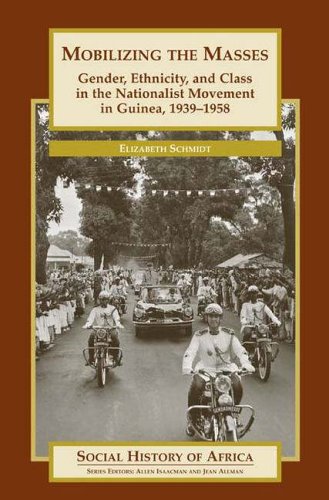

Mobilizing the Masses: Gender, Ethnicity, and Class in the Nationalist Movement in Guinea, 1939-1958 (Social History of Africa Series)
Couldn't load pickup availability
About this book
Mobilizing the Masses: Gender, Ethnicity, and Class in the Nationalist Movement in Guinea, 1939-1958 (Social History of Africa Series) by Elizabeth Schmidt. paperback edition. ISBN: 9780325070308.
The Rassemblement Democratique Africain (RDA) led Guinea to independence in 1958, advancing a wave of decolonization that ultimately swept across Africa. Schmidt attributes the RDAs overwhelming success to its ability to form a broad ethnic, class, and gender alliance, whose strength lay in its solid support among the non-literate masses. Key to the partys prowess was its focus on groups already engaged in struggle against the state: military veterans, urban workers, peasants, and women. It was their grievances that drove the nationalist agenda and their energies that were harnessed in the struggle for independence. The source of the partys strength was also the root of its greatest weakness. Disputes over ethnicity, class, and gender, and eruptions of ethnically based political violence, were a constant threat to the nationalist movement. Ultimately, it was the RDAs radical base that rejected junior partnership in the French Community, pushing the party leadership to endorse immediate independence. Based on previously unexamined archival records and oral interviews with rank-and-file RDA members, this book reinterprets nationalist history by approaching it from the bottom up. It illuminates the ways in which grassroots activists shaped the movements vision, objectives, and strategies. The significance of Schmidts work extends far beyond Guinea. It raises important theoretical and methodological issues that transform our understanding of anti-colonial nationalism in the non-Western world.