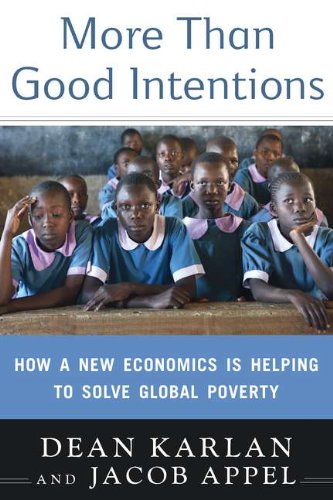

More Than Good Intentions: How a New Economics Is Helping to Solve Global Poverty
Couldn't load pickup availability
About this book
More Than Good Intentions: How a New Economics Is Helping to Solve Global Poverty by Appel, Jacob. hardcover edition. ISBN: 9780525951896.
A leading economist and researcher report from the front lines of a revolution in solving the worlds most persistent problem. When it comes to global poverty, people are passionate and polarized. At one extreme: We just need to invest more resources. At the other: Weve thrown billions down a sinkhole over the last fifty years and accomplished almost nothing. Dean Karlan and Jacob Appel present an entirely new approach that blazes an optimistic and realistic trail between these two extremes. In this pioneering book Karlan and Appel combine behavioral economics with worldwide field research. They take readers with them into villages across Africa, India, South America, and the Philippines, where economic theory collides with real life. They show how small changes in banking, insurance, health care, and other development initiatives that take into account human irrationality can drastically improve the well-being of poor people everywhere. We in the developed world have found ways to make our own lives profoundly better. We use new tools to spend smarter, save more, eat better, and lead lives more like the ones we imagine. These tools can do the same for the impoverished. Karlan and Appels research, and those of some close colleagues, show exactly how. In America alone, individual donors contribute over two hundred billion to charity annually, three times as much as corporations, foundations, and bequests combined. This book provides a new way to understand what really works to reduce poverty; in so doing, it reveals how to better invest those billions and begin transforming the well-being of the world.