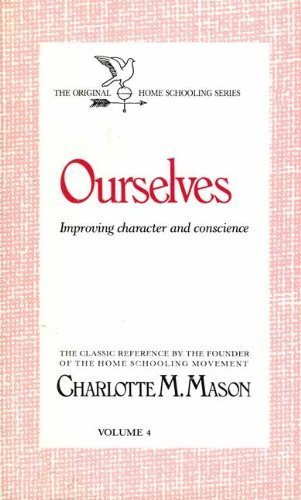

Ourselves (The Homeschoolers Series)
Couldn't load pickup availability
About this book
Ourselves (The Homeschoolers Series) by Mason, Charlotte M.. paperback edition. ISBN: 9780842313582.
Ourselves, the fourth volume of Charlotte Masons Classic Homeschooling Series, is a character curriculum book written directly to children. Book I, Self-Knowledge, is for elementary school students; Book II, Self-Direction, is for older students. Self-Knowledge discusses our human desires and appetites; the "helpers" in our minds, such as intellect, sense of beauty, imagination, and reason; the ways in which we feel and express love for others, including sympathy, kindness, generosity, gratitude, courage, loyalty, and humilty; and truth, justice, and integrity; and ends by encourages children to develop the habit of being useful. Self-Direction is an in-depth discussion of the conscience and virtues such as temperance, chastity, fortitude, and prudence; the will and self-control; and the soul and its capacities, such as prayer, thanksgiving, faith, and praise. Charlotte Mason was a late nineteenth-century British educator whose ideas were far ahead of her time. She believed that children are born persons worthy of respect, rather than blank slates, and that it was better to feed their growing minds with living literature and vital ideas and knowledge, rather than dry facts and knowledge filtered and pre-digested by the teacher. Her method of education, still used by some private schools and many homeschooling families, is gentle and flexible, especially with younger children, and includes first-hand exposure to great and noble ideas through books in each school subject, conveying wonder and arousing curiosity, and through reflection upon great art, music, and poetry; nature observation as the primary means of early science teaching; use of manipulatives and real-life application to understand mathematical concepts and learning to reason, rather than rote memorization and working endless sums; and an emphasis on character and on cultivating and maintaining good personal habits. Schooling is teacher-directed, not child-led, but school time should be short enough to a