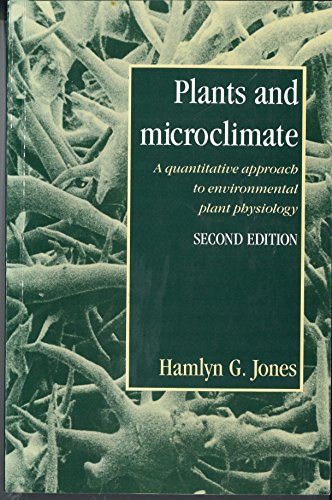
Plants and Microclimate: A Quantitative Approach to Environmental Plant Physiology
Couldn't load pickup availability
About this book
Plants and Microclimate: A Quantitative Approach to Environmental Plant Physiology by Jones, Hamlyn G.. paperback edition. ISBN: 9780521425247.
This book attempts to provide a soundly based introduction to those features of the atmospheric environment of particular relevance to plants; it also describes the physical and physiological principles required for understanding how these factors affect plants. The underlying biophysics and biochemistry are explained in the context of plants growing in their natural environment. For example, gas exchange and diffusion are considered in relation to the control both of evaporation from vegetation and of photosynthesis and productivity, while energy exchanges are examined in relation to plant temperature regulation. Throughout the text a quantitative approach is adopted and the use of mathematical models is described with some examples. Physiological and ecological aspects of adaptation to different natural environments, including mechanisms of drought tolerance, are considered, as are possible ways in which this information can be used for improving crop plants for selective breeding. Practical aspects of important measurement techniques are discussed. There is a comprehensive reference list giving an introduction to recent literature, together with appendixes listing useful physical qualities. The presentation adopted is designed to emphasize the close relationship among the biophysical, physiological, and ecological aspects of the adaptation of higher plants to their aerial environment. This second edition has been fully updated and includes information on novel techniques such as chlorophyll-a fluorescence and carbon isotope discrimination, which can be applied to plants in the field, as well as coverage of topics of current concern such as global warming and atmospheric pollution.