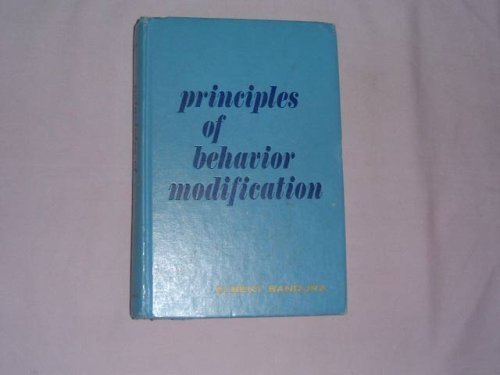
Principles of Behavior Modification
Couldn't load pickup availability
About this book
Principles of Behavior Modification by Bandura, Albert. paperback edition. ISBN: 9780030811517.
Dr Bandura presents basic psychological principles governing human thought and behavior within the conceptual framework of social learning. This theory emphasizes the prominent roles played by vicarious, symbolic, and self-regulatory processes in psychological functioning. Dr Bandura believes the reason for the sustained interest in this book is because it provided a unified conceptual framework within which to study diverse psychological phenomena and it specified procedures for effecting change. Behavior modification is the use of empirically demonstrated behavior change techniques to increase or decrease the frequency of behaviors, such as altering an individuals behaviors and reactions to stimuli through positive and negative reinforcement of adaptive behavior and/or the reduction of behavior through its extinction, punishment and/or satiation. Most behavior modification programs currently used are those based on Applied behavior analysis (ABA), formerly known as the experimental analysis of behavior which was pioneered by B. F. Skinner. Albert Bandura b.12/4/1925, in Mundare, Alberta, Canada is a psychologist who is the David Starr Jordan Professor Emeritus of Social Science in Psychology at Stanford University. Over almost six decades, he has been responsible for contributions to many fields of psychology, including social cognitive theory, therapy and personality psychology, and was also influential in the transition between behaviorism and cognitive psychology. He is known as the originator of social learning theory and the theory of self-efficacy, and is also responsible for the influential 1961 Bobo doll experiment.