
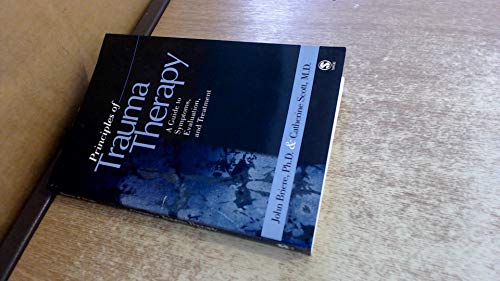
Principles of Trauma Therapy: A Guide to Symptoms, Evaluation, and Treatment
Couldn't load pickup availability
About this book
Principles of Trauma Therapy: A Guide to Symptoms, Evaluation, and Treatment by Scott, Catherine. paperback edition. ISBN: 9780761929215.
"This is a phenomenal compilation of clinical, biological, neuropsychiatric, and psychotherapeutic information on the subject of trauma. The authors move from the very basic subject of "what trauma is" to the most complicated subjects of etiology and intervention. The usefulness of the book is greatly enhanced by the many case examples. This is a major contribution, both for those who treat and for theoreticians.... a must for every clinician!" "This is a phenomenal compilation of clinical, biological, neuropsychiatric, and psychotherapeutic information on the subject of trauma. The authors move from the very basic subject of "what trauma is" to the most complicated subjects of etiology and intervention. The usefulness of the book is greatly enhanced by the many case examples. This is a major contribution, both for those who treat and for theoreticians.... a must for every clinician!" ―Marcia Goin, MD, PhD, Psychoanalyst; Past-president, American Psychiatric Association; Professor of Clinical Psychiatry, Keck School of Medicine, University of Southern California, Los Angeles, CA "This book is an excellent teaching tool ―almost what one would expect from a course with details printed in different fonts and useful checklists for clinical work. I appreciate the choice of either reading individual chapters one at a time, each one with recommended reading sections at the end, or the benefits of reading the book as a whole...Of special value in this book is the chapter dedicated to the psychopharmacology of trauma, as special attention is given to the most up-to-date research in the field of psychobiology" ―CONTEMPORARY PSYCHOLOGY Principles of Trauma Therapy provides a creative synthesis of cognitive-behavioral, relational/psychodynamic, and psychopharmacologic approaches to the "real world" treatment of acute and chronic posttraumatic states. Grounded in empirically-supported trauma treatment techniques, and adapted to the complexities of actual clinical practice, it is a hands-on resource for both front-line clinicians in public mental health and those in private practice. Trauma-related disturbance can be complex, requiring careful assessment and multimodal, symptom-focused treatment. This book describes assessment approaches and specific interventions not only for the cognitive and emotional processing of trauma memories, but also for the treatment of problems related to affect dysregulation, identity/self-disturbance, cognitive distortions, negative relational schema, and avoidance responses such as substance abuse, dissociation, and tension-reduction behavior. A special chapter on trauma psychopharmacology, accessible to both prescribing and nonprescribing clinicians, outlines the indications and limitations of psychoactive medication in the treatment of trauma survivors. Written by trauma researcher and clinician John Briere, Ph.D., and medical director of the USC Psychological Trauma Clinic, Catherine Scott, M.D., this book articulates a nonpathologizing, phenomenological perspective on trauma and recovery - one that emphasizes both specific therapeutic techniques and the general, but critical, role of the therapeutic relationship. Intended Audience: This is an essential resource for practicing clinicians interested in the area of trauma. It also serves as an ideal supplemental text for graduate students studying psychotherapy, clinical psychology, and traumatic stress in the fields of Psychology, Psychiatry, and Social Work.
