HomeComputers & TechnologyProgramming Language Pragmatics
Skip to product information
1 of 1

Programming Language Pragmatics

hardcoverOctober 25, 1999
Regular price $36.65 USD
Regular price Sale price $36.65 USD
Sale Sold out
Shipping calculated at checkout.
Secure Checkout
Quality Guaranteed
New In Stock
ISBN-13: 9781558604421 ISBN-10: 1558604421
Publisher
Elsevier
Binding
hardcover
Published
October 25, 1999
Weight
3.5 lbs
Dimensions
24.80×4.40×21.00 cm

About this book

Programming Language Pragmatics by Scott, Michael. hardcover edition. ISBN: 9781558604421.
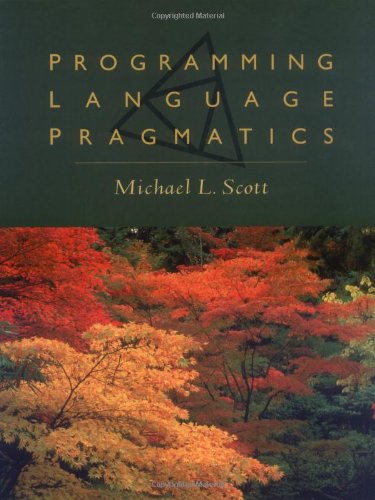
Programming Language Pragmatics addresses the fundamental principles at work in the most important contemporary languages, highlights the critical relationship between language design and language implementation, and devotes special attention to issues of importance to the expert programmer. Thanks to its rigorous but accessible teaching style, youll emerge better prepared to choose the best language for particular projects, to make more effective use of languages you already know, and to learn new languages quickly and completely. * Addresses the most recent developments in programming language design, spanning more than forty different languages, including Ada 95, C, C++, Fortran 95, Java, Lisp, Scheme, ML, Modula-3, Pascal, and Prolog. * Places a special emphasis on implementation issues-how the techniques used by compilers and related tools influence language design, and vice versa. * Covers advanced topics in language design and implemenation, such as iterators, coroutines, templates (generics), separate compilation, I/O, type inference, and exception handling. * Reviews language-related topics in assembly-level architecture critical for understanding what a compiler does to a program. * Offers in-depth coverage of object-oriented programming, including multiple inheritance and dynamic method binding. * Devotes a special section to static and dynamic linking. * Includes a comprehensive chapter on concurrency, with detailed coverage of both shared-memory and message-passing languages and libraries. * Provides an accessible introduction to the formal foundations of compilation (automata theory), functional programming (lambda calculus), and logic programming (predicate calculus).