
HomePolitics & Social Sciences BooksRace, Police, and the Making of a Political Identity: Mexican Americans and the Los Angeles Police Department, 1900-1945 (Latinos in American Society and Culture) (Volume 7)
Skip to product information
1 of 1

Race, Police, and the Making of a Political Identity: Mexican Americans and the Los Angeles Police Department, 1900-1945 (Latinos in American Society and Culture) (Volume 7)

paperbackSeptember 1, 1999
Regular price $28.03 USD
Regular price Sale price $28.03 USD
Sale Sold out
Shipping calculated at checkout.
Secure Checkout
Quality Guaranteed
New In Stock
ISBN-13: 9780520213357 ISBN-10: 0520213351
Publisher
University of California Press
Binding
paperback
Published
September 1, 1999
Weight
1.1 lbs
Dimensions
22.80×2.40×15.20 cm

About this book

Race, Police, and the Making of a Political Identity: Mexican Americans and the Los Angeles Police Department, 1900-1945 (Latinos in American Society and Culture) (Volume 7) by Escobar, Edward J. J.. paperback edition. ISBN: 9780520213357.
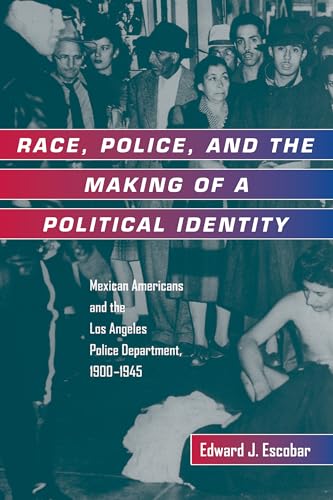
In June 1943, the city of Los Angeles was wrenched apart by the worst rioting it had seen to that point in the twentieth century. Incited by sensational newspaper stories and the growing public hysteria over allegations of widespread Mexican American juvenile crime, scores of American servicemen, joined by civilians and even police officers, roamed the streets of the city in search of young Mexican American men and boys wearing a distinctive style of dress called a Zoot Suit. Once found, the Zoot Suiters were stripped of their clothes, beaten, and left in the street. Over 600 Mexican American youths were arrested. The riots threw a harsh light upon the deteriorating relationship between the Los Angeles Mexican American community and the Los Angeles Police Department in the 1940s. In this study, Edward J. Escobar examines the history of the relationship between the Los Angeles Police Department and the Mexican American community from the turn of the century to the era of the Zoot Suit Riots. Escobar shows the changes in the way police viewed Mexican Americans, increasingly characterizing them as a criminal element, and the corresponding assumption on the part of Mexican Americans that the police were a threat to their community. The broader implications of this relationship are, as Escobar demonstrates, the significance of the role of the police in suppressing labor unrest, the growing connection between ideas about race and criminality, changing public perceptions about Mexican Americans, and the rise of Mexican American political activism.