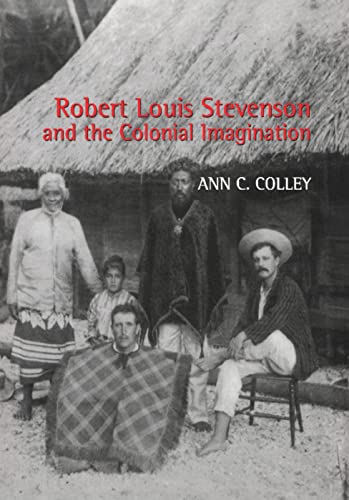
Robert Louis Stevenson and the Colonial Imagination
Couldn't load pickup availability
About this book
Robert Louis Stevenson and the Colonial Imagination by Colley, Ann C.. hardcover edition. ISBN: 9780754635062.
In her distinguished and hauntingly rendered book, Ann C. Colley provides a fresh insight into Stevensons multi-voiced South Seas fiction, as well as into the particulars and complications of living within a newly established site of Empire. Bringing to light information from the archives of the London Missionary Society and from other sources, such as the Royal Geographical Society (London), the Writers Museum (Edinburgh), the Beinecke Library (Yale University), and the Huntington Library (San Marino, California), Colley examines the intricate nature of Robert Louis Stevensons relation to imperialism. In particular, she investigates Stevensons complex relationship to the missionary culture that surrounded him during the last six years of his life (1888-1894), revealing hitherto unscouted routes by which to understand Stevensons experiences while he was cruising among the South Sea islands, and later while he was a resident colonial in Samoa. Beginning with a history of the missionaries in the Pacific that reveals Stevensons criticism of, yet ultimate support for, their work, and demonstrates how these attitudes helped shape his South Sea fiction, Robert Louis Stevenson and the Colonial Imagination constitutes a major work of reconstruction from archival sources. Subsequent chapters focus on Stevensons struggles with personal and cultural identity in the South Seas, and his interest in photography, panoramas, and magic lantern shows, revealing Stevensons sensitivity to the ways light plays upon darkness to create meaning. In addition, Stevensons serious commitment to political issues and his thoughts about power and nationhood are explored. Finally, Stevensons recollections of his childhood are engaged not only to suggest an unacknowledged source (the juvenile missionary magazines) for A Childs Garden of Verses, but also to illuminate the generous reach of his imagination that exceeds the formulae of the missionary culture and the boundaries of the colonial construct.