
Secret Mesa: Inside Los Alamos National Laboratory
Couldn't load pickup availability
About this book
Secret Mesa: Inside Los Alamos National Laboratory by Shroyer, Jo Ann. hardcover edition. ISBN: 9780471040637.
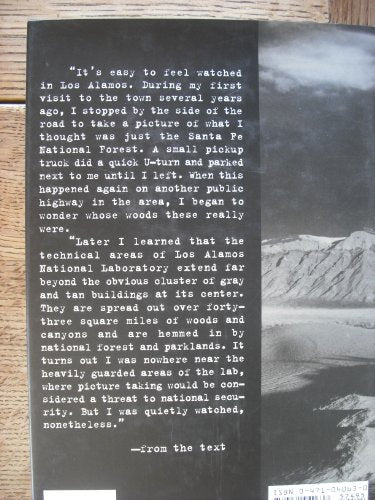
"Its easy to feel watched in Los Alamos. During my first visit to the town several years ago, I stopped by the side of the road to take a picture of what I thought was just the Santa Fe National Forest. A small pickup truck did a quick U-turn and parked next to me until I left. When this happened again on another public highway in the area, I began to wonder whose woods these really were. "Later I learned that the technical areas of Los Alamos National Laboratory extend far beyond the obvious cluster of gray and tan buildings at its center. They are spread out over forty-three square miles of woods and canyons and are hemmed in by national forest and parklands. It turns out I was nowhere near the heavily guarded areas of the lab, where picture taking would be considered a threat to national security. But I was quietly watched, nonetheless." —from the text "Its easy to feel watched in Los Alamos," begins award-winning journalist Jo Ann Shroyer in this engrossing profile of life and work inside the worlds most notorious science research center. Los Alamos is a world unto itself, rife with contradictions, haunted by its history, and yet bustling with an astonishing range of forefront science projects, from cancer research to the building of robotic ants. This is a town with the highest concentration of Ph.D.s anywhere in the world; where children sometimes arent allowed to know what their parents do for a living; and where weapons designers offer philosophical insights into why only deadly weapons can ensure lasting peace. Created as a top-secret outpost on a desolate mesa in the New Mexico desert—exclusively for the purpose of assembling the worlds first atomic weapon—Los Alamos was transformed during the Cold War into a high-powered science complex and full-blown "company town," with a population of 20,000, covering forty-three square miles and including schools, stores, churches, and a private ski slope. But even today, the town is tightly guarded by a 400-strong special security force, and glinting barriers of razor wire encircle research facilities protected by motion detectors and patrolled by armed guards. As Shroyer probes behind closed doors, she finds a complex, colorful, and thoughtful community grappling with the legacy of its nuclear-tainted past and confronting the challenge of defining its future in the post-Cold War era. Drawing on extensive interviews with scientists and residents, from weapons designers to peace activists, she takes us into their labs and homes and explores the surprising range of their insights and research. We accompany her as she "goes behind the fence" to visit the X-2 thermonuclear weapons facility and talk with weapons designer James "Jas" Mercer-Smith, who describes the labs mission as "trying to keep people from killing themselves in vast numbers." We meet robot scientist Mark Tilden and witness the lively antics of the menagerie of mechanical creatures he calls his "Robot Jurassic Park." And we visit the bizarre junkyard overflowing with "techno trash" run by peace activist Ed Grothus, where he sells research materials, discarded by lab facilities that he ironically dubs nuclear waste. A rich and evocative portrait of an intriguing, closed world, Secret Mesa ultimately offers a unique perspective on the complex questions surrounding the appropriate role, if any, for nuclear weapons in our future as well as the role of government-sponsored "big science" in spearheading much of the basic research so important to scientific progress.