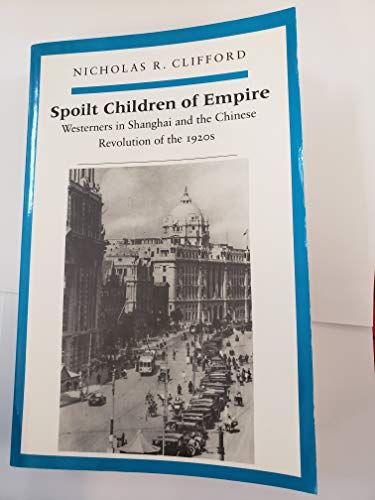

Spoilt Children of Empire: Westerners in Shanghai and the Chinese Revolution of the 1920s
Couldn't load pickup availability
About this book
Spoilt Children of Empire: Westerners in Shanghai and the Chinese Revolution of the 1920s by Clifford, Nicholas R.. paperback edition. ISBN: 9780874515954.
"For almost a century following the Opium War of 1842, Shanghai was the home of a largely autonomous expatriate community made up of businessmen and missionaries, educators and adventurers, Britons and Americans, French and Russians. Dubbed the "Paris of the Orient" and "paradise of adventurers," Shanghai was a treaty port whose self-governing foreign enclaves were free from both Chinese law and restrictions from abroad. Yet even as it grew to become Chinas largest, wealthiest city in the 1920s, Shanghais foreigners found themselves more and more out of touch with their host country and home societies, embracing a narrow, intolerant perception of the world that visitors described as the "Shanghai mind." In 1925 this outdated worldview was thrown into stark relief by the emergence of a new and radical nationalism. Nicholas Clifford presents here the clearest and most detailed portrait of this colorful expatriate community at a time when it was caught between revolutionary forces in China and the western worlds changing view of imperialism abroad."Clifford combines diplomatic and social history by focusing on a level where policy-making, local society, and politics intersect. Based largely on unpublished government and private documents in Washington, London, Paris, Taipei, and Shanghai, his book reconstructs the peculiar ambience of a foreign colonial community living in the citys International Settlement and French Concession, isolated from the tragic realities of China. He relates how the various foreign contingents coexisted socially and politically, how they desired autonomy from their consulates and legations yet expected defense in times of trouble, and how they saw Shanghai as a model for Chinas future. Ironically, the freedom and stability of the foreign enclaves provided a haven for such revolutionaries as Sun Yat-sen, and the French Concession was the site of the Communist Partys first congress in 1921. When revolution came to the streets of Shanghai in 1925, the expatriates failed to realize that this was not a matter of feuding warlords but rather a new kind of nationalism that would grant no place for foreign privilege. Clifford succeeds in bringing to life a remarkable chapter on the twilight of western imperialism and the emergence of modern China." (Inside cover)