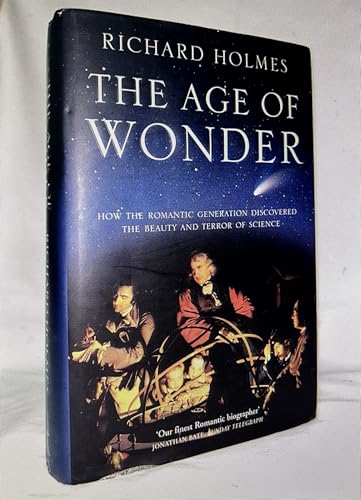
The Age of Wonder: How the Romantic Generation Discovered the Beauty and Terror of Science
Couldn't load pickup availability
About this book
The Age of Wonder: How the Romantic Generation Discovered the Beauty and Terror of Science by Holmes, Richard. hardcover edition. ISBN: 0884158778239.
A riveting history of the men and women whose discoveries and inventions at the end of the eighteenth century gave birth to the Romantic Age of Science. When young Joseph Banks stepped onto a Tahitian beach in 1769, he hoped to discover Paradise. Inspired by the scientific ferment sweeping through Britain, the botanist had sailed with Captain Cook on his first Endeavour voyage in search of new worlds. Other voyages of discovery—astronomical, chemical, poetical, philosophical—swiftly follow in Richard Holmes’s original evocation of what truly emerges as an Age of Wonder. Brilliantly conceived as a relay of scientific stories, The Age of Wonder investigates the earliest ideas of deep time and space, and the explorers of “dynamic science,” of an infinite, mysterious Nature waiting to be discovered. Three lives dominate the book: William Herschel and his sister Caroline, whose dedication to the study of the stars forever changed the public conception of the solar system, the Milky Way, and the meaning of the universe; and Humphry Davy, who, with only a grammar school education stunned the scientific community with his near-suicidal gas experiments that led to the invention of the miners’ lamp and established British chemistry as the leading professional science in Europe. This age of exploration extended to great writers and poets as well as scientists, all creators relishing in moments of high exhilaration, boundary-pushing and discovery. Holmes’s extraordinary evocation of this age of wonder shows how great ideas and experiments—both successes and failures—were born of singular and often lonely dedication, and how religious faith and scientific truth collide. He has written a book breathtaking in its originality, its storytelling energy, and its intellectual significance.