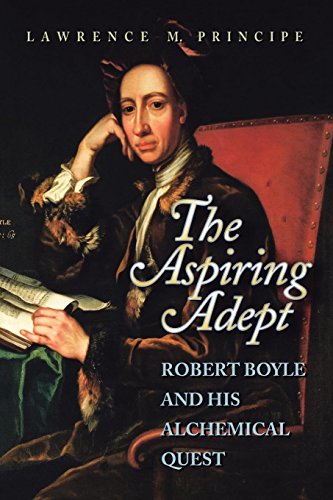
The Aspiring Adept
Couldn't load pickup availability
About this book
The Aspiring Adept by Principe, Lawrence. hardcover edition. ISBN: 9780691016788.
The Aspiring Adept presents a provocative new view of Robert Boyle (1627-1691), one of the leading figures of the Scientific Revolution, by revealing for the first time his avid and lifelong pursuit of alchemy. Boyle has traditionally been considered, along with Newton, a founder of modern science because of his mechanical philosophy and his experimentation with the air-pump and other early scientific apparatus. However, Lawrence Principe shows that his alchemical quest--hidden first by Boyles own codes and secrecy, and later suppressed or ignored--positions him more accurately in the intellectual and cultural crossroads of the seventeenth century. Principe radically reinterprets Boyles most famous work, The Sceptical Chymist, to show that it criticizes not alchemists, as has been thought, but "unphilosophical" pharmacists and textbook writers. He then shows Boyles unambiguous enthusiasm for alchemy in his "lost" Dialogue on the Transmutation and Melioration of Metals, now reconstructed from scattered fragments and presented here in full for the first time. Intriguingly, Boyle believed that the goal of his quest, the Philosophers Stone, could not only transmute base metals into gold, but could also attract angels. Alchemy could thus act both as a source of knowledge and as a defense against the growing tide of atheism that tormented him. In seeking to integrate the seemingly contradictory facets of Boyles work, Principe also illuminates how alchemy and other "unscientific" pursuits had a far greater impact on early modern science than has previously been thought.