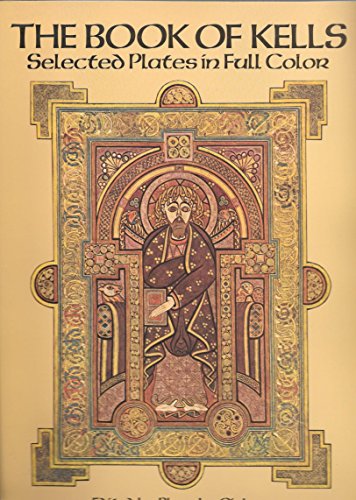

The Book of Kells: Selected Plates in Full Color
Couldn't load pickup availability
About this book
"Here you may see the face of majesty divinely drawn here the mystic symbols of the Evangelists. . . . You will make out intricacies so delicate and subtle so exact and compact so full of knots and links with colours so fresh and vivid that you might say that all this was the work of an angel and not of a man." Giraldus Cambrensis Topographia Hiberniae ca. 1185.Gerald of Wales wrote his ecstatic description of what is most probably the Book of Kells 800 years ago some 300 years after the work appeared. It remains the best description; he felt and conveyed the Books power the mystery that made it even then unique among early medieval manuscripts. While clearly subject to international influence (Celtic British Norman; possibly Italian Byzantine and Coptic) the Book of Kells painters and scribes illumined their work with a purely idiosyncratic beauty. The Book of Kells is more an icon than a typical evangelistary; indeed the Saint Jerome text of the gospels is frequently corrupt or carelessly rendered so intent were the artists on their ornament and iconography. One may still see the glorious ornament on display at Trinity College Dublin; a more accessible version is this newly reproduced from a rare facsimile edition. Thirty-two full-page full-color plates have been selected and painstakingly printed to retain the ineffable handpainted impression of the original leaves. All the full-page decorations portraits and illustrations are included as well as a representative sampling of the textual leaves in their graceful Insular (half-uncial) calligraphy interspersed and initialed with an imaginative fanciful and even humorous bestiary of lions lambs eagles otters cats dragons birds fish and snakes; strange men are seen in the cross-armed Osiris position entwined in lions tails snakes vines and peacock feathers. The interlacing and spiraling follow the Insular tradition; in botanical ornament the Book stands apart from that school. The illustrations include vital specimens of Western art: the first image of the Virgin and Child in a Western manuscript and numerous early representations of the Apocalyptic visionary symbols of the Evangelists; symbols that lost their eeriness in later diluted form but that in the Book of Kells according to one scholar "retain their wild unearthly quality. They are perhaps the most striking element in the decoration of the Book." Perusers of this Book casual and serious students of art religion or Western culture will echo Giraldus who wrote: "For my part the oftener I see the book and the more carefully I study it the more I am lost in ever fresh amazement and I see more and more wonders in the book."