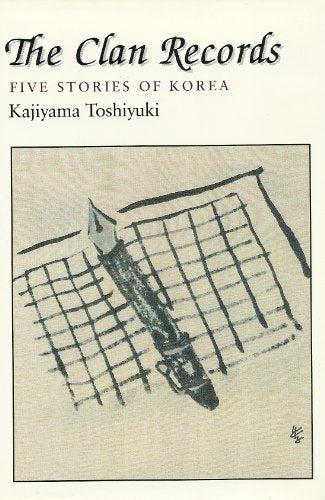

The Clan Records: Five Stories of Korea
hardcover
–
January 1, 1995
Regular price
$92.08 USD
Regular price
Sale price
$92.08 USD
Unit price
per
Shipping calculated at checkout.
Couldn't load pickup availability
Secure Checkout
Quality Guaranteed
In Stock
ISBN-13: 9780824815325
ISBN-10: 0824815327
About this book
Although little known in the West Kajiyama Toshiyuki was one of Japans most prolific and popular writers. Celebrated for his crisp fast-paced style and incisive analysis Kajiyamas popularity may be attributed to his finely tuned sense of what many Japanese felt but could not articulate: the feeling of irreplaceable loss that lay beneath post-World War II Japans highly successful economic recovery. The son of a civil engineer Kajiyama was born in Seoul in 1930 and remained there until his family was repatriated to Japan at the end of the war. The Clan Records: Five Stories of Korea not only offers a sampling of Kajiyamas work in English for the first time but also represents the first English translations from the Japanese that deal with Korea under Japans harsh military rule which lasted from 1910 to 1945. Kajiyama intended these tales to be one of the components of his "lifework " a trilogy that remained unfinished at the time of his death in 1975. Kajiyama had outlined a tour de force that was to have focused on three interlocking landscapes - Korea the place of his birth and childhood; Hawaii his mothers birthplace and the setting for the Japanese immigration experience; and Hiroshima his fathers birthplace and the site of the atomic bombing. The Clan Records includes five of Kajiyamas Korea tales among them the title story "Richo zanei " winner of the prestigious Naoki Prize and the basis of a highly acclaimed movie made in Korea in 1967. Laced with local expressions and accurate descriptions of Korean culture Kajiyamas narratives infuse his Korean protagonists with dignity and courage. They depict sensitive subjects in an unusually subtle and emphatic manner without being patronizing. In these stories too Kajiyama avoided the temptation to soften the often brutal consequences of the inhumanity of the Japanese occupation.