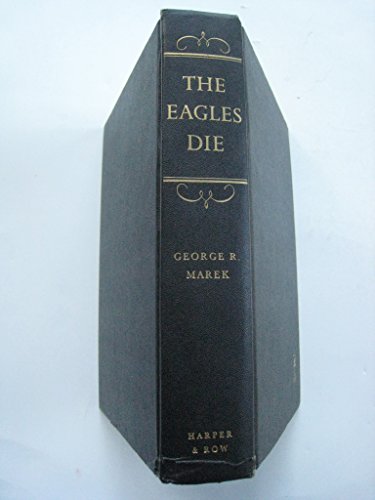
The eagles die: Franz Joseph Elisabeth and their Austria
Couldn't load pickup availability
About this book
Emperor Franz Joseph of Austria ruled the Austro-Hungarian Empire for 68 years succumbing at last at age 86 2 years after the start of WWI. When Franz Joseph succeeded to its command the Habsburg holdings included Milan & Venice Prague & Cracow as well as Vienna & Budapest. Within two years of his death the empire had been reduced to the small country centered on Vienna that it essentially is today. The Eagles Die is the story of that Habsburg sunset & of the golden light that Viennese culture shed in the waning days of empire. Vienna-born Author Marek takes the biographical tack in The Eagles Die concentrating upon Franz Joseph & Empress Elisabeth obviously hoping that it might do for Habsburg Austria what Nicholas & Alexandra did for Romanov Russia. He only partly succeeds mainly because his principal characters were intensely private imperial strangers both to their subjects and to each other. Of the two Elisabeth fares better perhaps because her spirit seems so restlessly contemporary. Though she married Franz Joseph when she was 16 and gave him a son and three daughters she played a lonely second fiddle to Franz Josephs imperious mother Sophie. Eventually the vivacious queen declared a kind of independence becoming the adored champion of the cause of home-rule for Hungary traveling incessantly: now to England to ride after hounds now to Turkey to explore Schliemanns Troy diggings. She even translated Shakespearean plays into modern Greek. Primping and dieting narcissistically she remained an international beauty until age 60 when killed by an Italian anarchist while boarding a steamer on Lake Geneva in 1898. Her marriage to Franz Joseph was one of the centurys great mismatches. While she fluttered through Europe he would rise before dawn to be at his royal desk by 5-6AM as absorbed in the minutiae of bureaucracy as a tax clerk. He apparently enjoyed the stultifying formality of the Hofburg. Once when he awoke very ill in the middle of the night he was able to bark only one phrase at the physician who had scurried to him: "Formal dress!" If hed any off-guard moments they were reserved for his marvelously bourgeois relationship with Actress Katherina Schratt a love lasting until he died. The Emperor regularly nipped down to Katherinas house for coffee after early morning Mass. Delighted Viennese fiacre divers called him "Herr Schratt." Marek makes clear that Franz Joseph was more than a uniformed bureaucrat. He was literally and psychologically a survivor. Hed come to power upon his uncles abdication during the 1848 Revolution and proceeded to put down and punish the rebels ruthlessly. He stubbornly refused to sell the region of Venetia for nearly $1 billion & then lost itand thousands of livesas a result of a disastrous war with Prussia. The survivors instinct could only have deepened as he saw his family cut down by firing squad and assassin: his younger brother Maximilian as Napoleon Ills cats paw in Mexico his son Rudolf as a result of a crime passionnel suicide pact at Mayerling his wife at Geneva his nephew Franz Ferdinand at Sarajevo. Was it some final bitterness over the parade of deaths that caused Franz Joseph to push Europe too into an orgy of killing as he declared war on Serbia in 1914? This is an uneven book but its solidly researched and when Marek stops to assess the contemporaneous accomplishments of Viennese civilization his view can be breathtaking. While Franz Joseph fretted over dreary details at his desk Bruckner Brahms & Mahler were writing some of historys greatest music & Johann Strauss some of its gayest. The young Kafka was turning out dismally prophetic stories in Prague (his sisters would die at Auschwitz). The young Freud was working out his theories of psychoanalysis. But the sun was dropping rapidly. Physically Franz Joseph had helped to build the graceful city that is modern Vienna. Spiritually he scarcely understood the city. He allowed himself to be dragooned to the opera as a sort of royal advertisement. But the man who ruled Viennas empire never once heard a symphony by Brahms.--Mayo Mohs (edited)