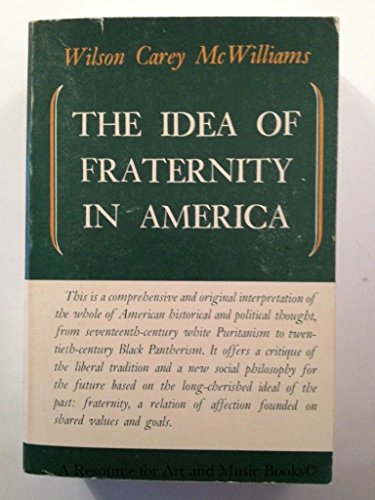
The Idea of Fraternity In America
Couldn't load pickup availability
About this book
"A vast workit illuminates the whole range of American political thought and its background." -- Louis Hartz This is a comprehensive and original interpretation of the whole of American historical and political thought from 17th-century white Puritanism to 20th-century Black Pantherism. It offers a critique of the liberal tradition and a new social philosophy for the future based on the long-cherished ideal of the past: fraternity a relation of affection founded on shared values and goals. This is a study of the idea of fraternity both as philosophic abstraction and as social-psychological reality in the American historical experience. In one sense it is a long and sustained reflection on the American political tradition with side glances at other cultures and other traditions; in another sense it is an impressive beginning at an original and quite comprehensive theory of politics rooted in a new reading of virtually every conceivable relevant source. Fraternity is a permanent social and psychological necessity of human development yet one that is discouraged and inhibited by the institutions and processes of modern industrial societies. In American two cultural traditions the formal and intellectual liberal tradition deriving from the Enlightenment and the religious tradition rooted in habit and custom appeal to the symbol of fraternity. The religious tradition sees fraternity as an ethic in intra-personal relations which is essentially a means to the goal of human excellence. The liberal tradition by contrast conceives fraternity as an end the chief characteristic of an ideal society to be reached by historical progress. Despite these radically different conceptions the fact that the liberal tradition promised fraternity at the end of historical progress enabled many Americans to escape from the ambivalence deriving from the widely divergent ethics of their two cultures and to accept modern institutions censured by the religious tradition on the assumption that these would work to produce fraternity. "This is an astonishing book -- in terms of scholarship of insight of breadth of vision. It is bound to become a major point of reference for any informed discussion of political ideas and political reality in America.Anyone concerned with the future of democracy will be profoundly stimulated by this truly remarkable book." -- Peter Berger