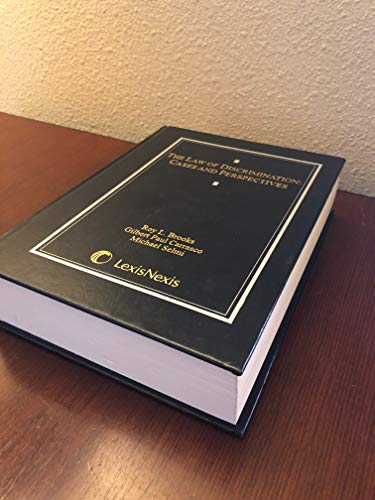
The Law of Discrimination: Cases and Perspectives
Couldn't load pickup availability
About this book
The Law of Discrimination: Cases and Perspectives by Roy L. Brooks. hardcover edition. ISBN: 9781422480380.
View or download the free 2016 Online Supplement for this product. The Law of Discrimination: Cases and Perspectivess major pedagogical objective is to guide students through the increasingly complex field of discrimination cases and doctrine, and to offer a diversity of perspectives that underpin or challenge the canon. While most of the seminal cases included in this casebook, like most civil rights casebooks, involve discrimination based on race, The Law of Discrimination discusses protections for other classes, including women, language minorities, older workers, and the disabled. Affirmative action, an important component of discrimination law, is also covered extensively. In addition, several perspectives on discrimination law are presented. These perspectives offer students insights into intellectual frameworks that shape opinions and doctrines. They also provide students with conceptual tools for challenging received traditions in discrimination law―"thinking outside the box." In sum, this casebook covers more ground than the typical civil rights casebook. Chapter 1 opens by raising new as well as recurring themes reflected in modern discrimination law, including questions of race vs. class, racial identity, racial integration vs. racial separation, and the extent to which all racial minorities face the same race problem. Formal equal opportunity, which is the nations current civil rights policy, and its predecessor civil rights policies are examined. The chapter ends with a presentation of both liberal and oppositional civil rights perspectives in contrast to formal equal opportunity. Chapter 1 sets the stage for a sophisticated and enlivened discussion of discrimination law. The remaining nine chapters are case-oriented and deal with specific areas of discrimination. A comprehensive Teachers Manual is available to professors.