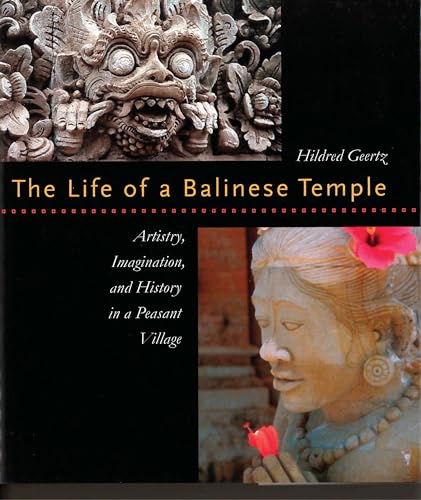
The Life of a Balinese Temple: Artistry, Imagination, and History in a Peasant Village
Couldn't load pickup availability
About this book
The Life of a Balinese Temple: Artistry, Imagination, and History in a Peasant Village by Geertz, Hildred. hardcover edition. ISBN: 9780824825331.
Should a temple be seen as a work of art, its carvers as artists, its worshipers as art critics and patrons? What is a temple (and its art) to the people who make and use it? Noted anthropologist Hildred Geertz attempts to answer these and other questions in this unique look at transformations in material culture and social relations over time in a village temple in Bali. Throughout Geertz offers insightful glimpses into what the statues, structures, and designs of Pura Désa Batuan convey to those who worship there, deepening our understanding of how a village community evaluates workmanship and imagery. Following an introduction to the temple and villagers of Batuan, Geertz explores the problematics of the Western concept of "art" as a guiding framework in research. She goes on to outline the many different kinds of work―ideational as well as physical―undertaken in connection with the temple and the social institutions that enable, constrain, and motivate their creation. Finally, the "art-works" themselves are presented, set within the intricate sociocultural contexts of their making. Using the history of Batuan as the main framework for discussing each piece, Geertz looks at the carvings from the perspective of their makers, each generation occupying a different social situation. She confronts concepts such as "aesthetics," "representation," "sacredness," and "universality" and the dilemmas they create in field research and ethnographic writing. Recent temple carvings from the tumultuous and complex period that followed the expulsion of the Dutch and the increasing globalization and commercialization of Balinese society demonstrate yet again that any anthropology of art must also be historical.