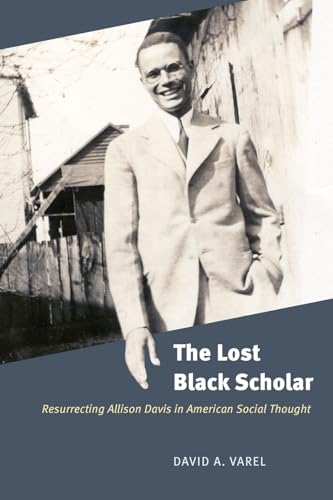
The Lost Black Scholar: Resurrecting Allison Davis in American Social Thought
Couldn't load pickup availability
About this book
The Lost Black Scholar: Resurrecting Allison Davis in American Social Thought by Varel, David A.. hardcover edition. ISBN: 9780226534886.
Allison Davis (1902–83), a preeminent black scholar and social science pioneer, is perhaps best known for his groundbreaking investigations into inequality, Jim Crow America, and the cultural biases of intelligence testing. Davis, one of America’s first black anthropologists and the first tenured African American professor at a predominantly white university, produced work that had tangible and lasting effects on public policy, including contributions to Brown v. Board of Education, the federal Head Start program, and school testing practices. Yet Davis remains largely absent from the historical record. For someone who generated such an extensive body of work this marginalization is particularly surprising. But it is also revelatory. In The Lost Black Scholar, David A. Varel tells Davis’s compelling story, showing how a combination of institutional racism, disciplinary eclecticism, and iconoclastic thinking effectively sidelined him as an intellectual. A close look at Davis’s career sheds light not only on the racial politics of the academy but also the costs of being an innovator outside of the mainstream. Equally important, Varel argues that Davis exemplifies how black scholars led the way in advancing American social thought. Even though he was rarely acknowledged for it, Davis refuted scientific racism and laid bare the environmental roots of human difference more deftly than most of his white peers, by pushing social science in bold new directions. Varel shows how Davis effectively helped to lay the groundwork for the civil rights movement.