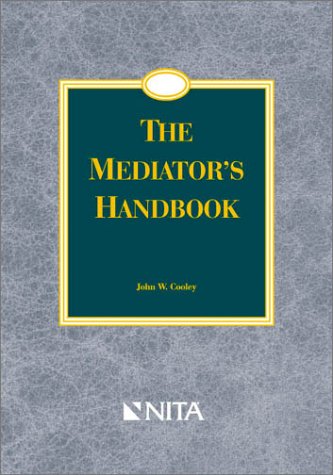

The Mediator's Handbook: Advanced Practice Guide for Civil Litigation
Couldn't load pickup availability
About this book
Because of mediations widespread use mediator skills have been elevated to the group of core skills needed by all law professionals. In this book John W. Cooley stresses that mediator skills training involves more than simply teaching techniques for resolving disputes. Skills training should also address essential lawyering attributes that carry over into every aspect of the practice of law such as competent service leadership professionalism and civility. Cooley presents an invaluable handbook that encompasses a broad range of practical and theoretical issues covering all stages of mediation. The Mediators Handbook compiles in one volume all the information needed by mediators who serve in a wide variety of litigation or litigation-related disputes. From the preliminary stage of mediation to the mediation session or conference to post-conference duties The Mediators Handbook provides a full range of features geared to assist the mediator in systematically performing his or her duties competently and efficiently. Chapter One contains basic information regarding the nature of mediation including a description of the stages and types as well as the benefits and limitations. It also defines the role authority and ethics requirements of the mediator. Chapter Two provides a comprehensive description of the types of communication skills that the mediator needs to perform his or her functions effectively. Chapter Three describes the mediators preconference functions and duties such as how to choose a co-mediator how to plan and conduct a preliminary caucus or joint meeting and the specific steps to follow in preparing for the mediation session. This chapter also provides useful suggestions on preparing for several types of complex mediation. Chapter Four focuses on the mediators conference functions and duties. In addition to setting forth comprehensive step-by-step guidance for delivering a mediators opening statement Cooley describes how to conduct the joint session initial caucuses restructural caucuses and decisional caucuses. This chapter also describes the distinctions between the mediators function in facilitative evaluative and transformative mediation processes. Chapter Five addresses the mediators post-conference functions and duties and Chapter Six describes the hybrid non-mediational processes. The appendices contain checklists to ensure that the mediator does not forget to take key actions at critical stages of the mediation process and also contain sample mediation forms rules ethics and civility guidelines. Although written for experienced mediators of litigated disputes this book is also of interest to the novice mediator who has conducted a few supervised mediations and now wants to attempt a more complex dispute settling. The Mediators Handbook also contains valuable information for non-lawyer mediators such as counselors psychotherapists financial and estate planners and accountants who are commonly involved in domestic law disputes particularly in divorce mediation.