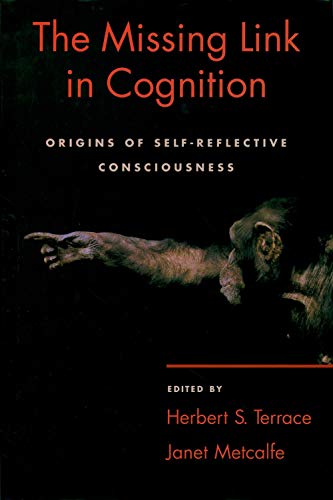
The Missing Link in Cognition: Origins of Self-Reflective Consciousness
Couldn't load pickup availability
About this book
The Missing Link in Cognition: Origins of Self-Reflective Consciousness by Terrace, Herbert S.. hardcover edition. ISBN: 9780195161564.
Are humans unique in having self-reflective consciousness? Or can precursors to this central form of human consciousness be found in non-human species? The Missing Link in Cognition brings together a diverse group of researchers who have been investigating this question from a variety of perspectives, including the extent to which non-human primates, and, indeed, young children, have consciousness, a sense of self, thought process, metacognitions, and representations. Some of the participants--Kitcher, Higgins, Nelson, and Tulving--argue that these types of cognitive abilities are uniquely human, whereas others--Call, Hampton, Kinsbourne, Menzel, Metcalfe, Schwartz, Smith, and Terrace--are convinced that at least the precursors to self-reflective consciousness exist in non-human primates. Their debate focuses primarily on the underpinnings of consciousness. Some of the participants believe that consciousness depends on representational thought and on the mental manipulation of such representations. Is representational thought enough to ensure consciousness, or does one need more? If one needs more, exactly what is needed? Is reflection upon the representations, that is, metacognition, the link? Does a realization of the contingencies, that is, "knowing that," in Gilbert Ryles terminology, ensure that a person or an animal is conscious? Is true episodic memory needed for consciousness, and if so, do any animals have it? Is it possible to have episodic memory or, indeed, any self-reflective processing, without language? Other participants believe that consciousness is inextricably intertwined with a sense of self or self-awareness. From where does this sense of self or self-awareness arise? Some of the participants believe that it develops only through the use of language and the narrative form. If it does develop in this way, what about claims of a sense of self or self-awareness in non-human animals? Others believe that the autobiographical record implied by episodic memory is fundamental. To what extent must non-human animals have the linguistic, metacognitive, and/or representational abilities to develop a sense of self or self-awareness? These and other related concerns are crucial in this volumes lively debate over the nature of the missing cognitive link, and whether gorillas, chimps, or other species might be more like humans than many have supposed.