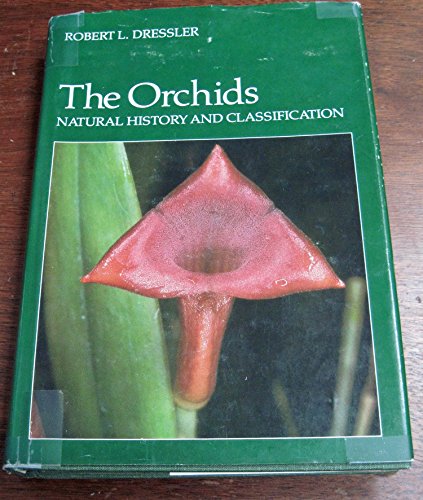
The Orchids: Natural History and Classification
Couldn't load pickup availability
About this book
The Orchids: Natural History and Classification by Dressler, Robert. hardcover edition. ISBN: 9780674875258.
This lively examination of the structure, classification, evolution, and ecology of the Orchidaceae will appeal to anyone with an eye for beauty or a bent for natural history. It will provide professional biologists and amateur orchidists alike with a deeper understanding--and a thoroughly new classification--of this, the largest flowering family in the plant kingdom. The book is richly illustrated, with 95 color photographs and 99 line drawings emphasizing orchid morphology. But in the context of serious orchidology, aesthetic richness is not a superficial vanity. It is the result of evolutionary processes that demand adaptation and reward diversity, and Dresslers exploration of these mechanisms demonstrates how well the orchids have met the challenge, with over 20,000 species, a geographical range from Sweden to Tierra del Fuego, and, at times, as many as 47 different species on a single tree. But both the orchids success and their profligate beauty are grounded, in part, in their voluptuary nature, and one of Dresslers most engaging themes is the reproductive adaptations, worthy of a Renaissance courtesan, that orchids use to attract, deceive, and manipulate pollinating insects. The orchid family is actively evolving, providing rich possibilities for comparative study. Yet no one, whether professional or amateur, could reasonably proceed without first addressing Robert Dresslers The Orchids. Its new classification alone, including pollination biology, phyletic trends, chromosome counts, and generic relationships, will stand as a watershed contribution to the field.