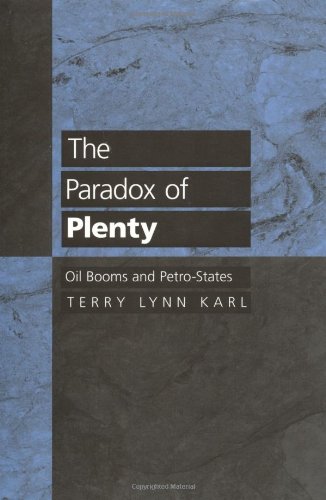
The Paradox of Plenty: Oil Booms and Petro-States (Volume 26) (Studies in International Political Economy)
Couldn't load pickup availability
About this book
The Paradox of Plenty: Oil Booms and Petro-States (Volume 26) (Studies in International Political Economy) by Karl, Terry Lynn. paperback edition. ISBN: 9780520207721.
The Paradox of Plenty explains why, in the midst of two massive oil booms in the 1970s, oil-exporting governments as different as Venezuela, Iran, Nigeria, Algeria, and Indonesia chose common development paths and suffered similarly disappointing outcomes. Meticulously documented and theoretically innovative, this book illuminates the manifold factors―economic, political, and social―that determine the nature of the oil state, from the coherence of public bureaucracies, to the degree of centralization, to patterns of policy-making. Karl contends that oil countries, while seemingly disparate, are characterized by similar social classes and patterns of collective action. In these countries, dependence on petroleum leads to disproportionate fiscal reliance on petrodollars and public spending, at the expense of statecraft. Oil booms, which create the illusion of prosperity and development, actually destabilize regimes by reinforcing oil-based interests and further weakening state capacity. Karls incisive investigation unites structural and choice-based approaches by illuminating how decisions of policymakers are embedded in institutions interacting with domestic and international markets. This approach―which Karl dubs "structured contingency"―uses a states leading sector as the starting point for identifying a range of decision-making choices, and ends by examining the dynamics of the state itself.