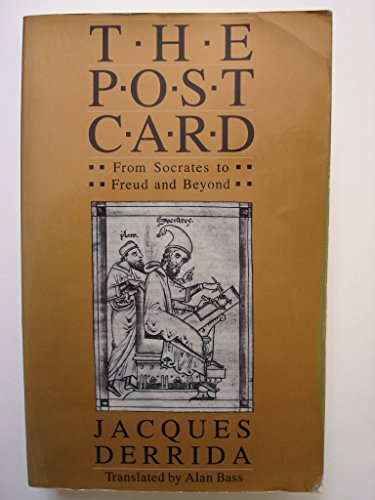

The Post Card: From Socrates to Freud and Beyond
Couldn't load pickup availability
About this book
17 November 1979 You were reading a somewhat retro loveletter the last in history. But you have not yet received it. Yes its lack or excess of address prepares it to fall into all hands: a post card an open letter in which the secret appears but indecipherably. What does a post card want to say to you? On what conditions is it possible? Its destination traverses you you no longer know who you are. At the very instant when from its address it interpellates you uniquely you instead of reaching you it divides you or sets you aside occasionally overlooks you. And you love and you do not love it makes of you what you wish it takes you it leaves you it gives you. On the other side of the card look a proposition is made to you S and p Socrates and plato. For once the former seems to write and with his other hand he is even scratching. But what is Plato doing with his outstretched finger in his back? While you occupy yourself with turning it around in every direction it is the picture that turns you around like a letter in advance it deciphers you it preoccupies space it procures your words and gestures all the bodies that you believe you invent in order to determine its outline. You find yourself you yourself on its path. The thick support of the card a book heavy and light is also the specter of this scene the analysis between Socrates and Plato on the program of several others. Like the soothsayer a "fortune-telling book" watches over and speculates on that-which-must-happen on what it indeed might mean to happen to arrive to have to happen or arrive to let or to make happen or arrive to destine to address to send to legate to inherit etc. if it all still signifies between here and there the near and the far da und fort the one or the other. You situate the subject of the book: between the posts and the analytic movement the pleasure principle and the history of telecommunications the post card and the purloined letter in a word the transference from Socrates to Freud and beyond. This satire of epistolary literature had to be farci stuffed with addresses postal codes crypted missives anonymous letters all of it confided to so many modes genres and tones. In it I also abuse dates signatures titles or references language itself. J. D. "With The Post Card as with Glas Derrida appears more as writer than as philosopher. Or we could say that here in what is in part a mock epistolary novel (the long section is called "Envois " roughly "dispatches" ) he stages his writing more overtly than in the scholarly works. . . . The Post Card also contains a series of self-reflective essays largely focused on Freud in which Derrida is beautifully lucid and direct."Alexander Gelley Library Journal