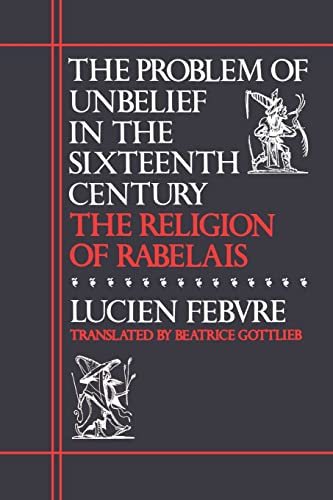
The Problem of Unbelief in the Sixteenth Century: The Religion of Rabelais
Couldn't load pickup availability
About this book
Lucien Febvres magisterial study of sixteenth century religious and intellectual history published in 1942 is at long last available in English in a translation that does it full justice. The book is a modern classic. Febvre founder with Marc Bloch of the journal Annales was one of Frances leading historians a scholar whose field of expertise was the sixteenth century. This book written late in his career is regarded as his masterpiece. Despite the subtitle it is not primarily a study of Rabelais; it is a study of the mental life the mentalit of a whole age. Febvre worked on the book for ten years. His purpose at first was polemical: he set out to demolish the notion that Rabelais was a covert atheist a freethinker ahead of his time. To expose the anachronism of that view he proceeded to a close examination of the ideas information beliefs and values of Rabelais and his contemporaries. He combed archives and local records compendia of popular lore the work of writers from Luther and Erasmus to Ronsard the verses of obscure neo-Latin poets. Everything was grist for his mill: books about comets medical texts philological treatises even music and architecture. The result is a work of extraordinary richness of texture enlivened by a wealth of concrete detailsa compelling intellectual portrait of the period by a historian of rare insight great intelligence and vast learning. Febvre wrote with Gallic flair. His style is informal often witty at times combative and colorful almost to a fault. His idiosyncrasies of syntax and vocabulary have defeated many who have tried to read let alone translate the French text. Beatrice Gottlieb has succeeded in rendering his prose accurately and readably conveying a sense of Febvres strong often argumentative personality as well as his brilliantly intuitive feeling for Renaissance France.