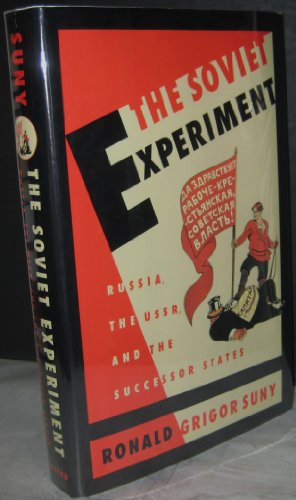
The Soviet Experiment: Russia The USSR and the Successor States
Couldn't load pickup availability
About this book
The West has always had difficulty understanding the Soviet Union. For decades analyses of Americas Cold War foe were clouded by ideological passions and a shear dearth of information. Then came the flood of dramatic revelations under glasnost followed by the sudden shocking collapse of the Communist empire. Today with the stunning secrets of newly opened archives and the excitement of political revolution still fresh in our minds and we can look back at this remarkable nation and see it whole see Soviet history as a story with a beginning a middle and an end. In The Soviet Experiment Ronald Grigor Suny does just that in a landmark work that gives us the fullest account yet of the most remarkable story of our century. With a clear-eyed mastery of the historical issues and literature Suny combines gripping detail with insightful analysis in a narrative that propels the reader from the last tsar of the Russian empire to the first president of the Russian republic. He focuses in particular on four revolutions each identified with a single individual: the tumultuous year of 1917 when Vladimir Lenin led the Bolshevik takeover of the tsarist empire; the 1930s when Joseph Stalin refashioned the economy the society and the state; Mikhail Gorbachevs ambitious and catastrophic attempt at sweeping reform and revitalization; and the breakup of the Soviet Union led by Boris Yeltsin. Never have we had a more complete nuanced and crystal-clear examination of the complex themes running through Soviet history. Suny confidently moves from party debates and personal rivalries to centuries-old ethnic tensions to vast economic and social developments. He unravels tangled issues with ease explaining "deeply contradictory" policies toward the various Soviet nationalities; Moscows ambivalence over its own New Economic Policy of the 1920s; and the attempts at reform that followed Stalins death. Sunys treatment of the Soviet break-up warrants particular attention as he details precisely how Gorbachevs program unleashed forces that had built up during the previous decades--particularly the nationalism that had been shaped ironically by the Soviet structure of ethnically defined republics. Along the way he offers a fresh telling of familiar as well as little-known events--capturing for example the movement of the crowds on the streets of St. Petersburg in the February revolution; Stalins collapse into a near-catatonic state after Hitlers much-predicted invasion; or Yeltsins political maneuvering and public grandstanding as he pushed the disintegration of the Soviet Union and then faced down his rivals. The Soviet Experiment provides a rich multilayered seamlessly woven account of one of the great forces of modern history. With dispassionate insight and human detail Suny has constructed a masterful work.