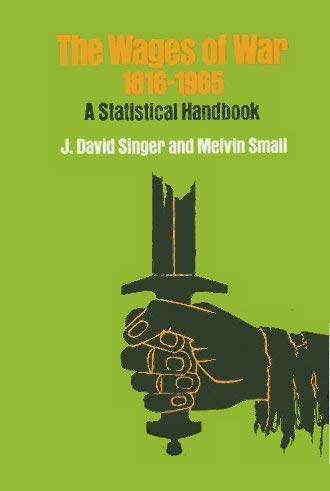
The Wages of War 1816-1965: A Statistical Handbook
Couldn't load pickup availability
About this book
Over seven years in preparation this is the first book-length report to emerge from the Correlates of War project. That project supported by the Carnegie Corporation and the National Science Foundation proceeds from the assumption that war - like other natural and man-made catastrophies - can be studied in a rigorous and scientific fashion. And as we increase our understanding of its correlates and its causes we increase the chances of making war less frequent and less destructive. This volume as well as the larger project is seen as a logical extension of the pioneering research of Quincy Wright and Lewis Richardson. Building on Wrights Study of War and Richardsons Statistics of Deadly Quarrels it offers the first fully operational set of data on modern international war. Exhaustive in its search and meticulous in its coding and computations it provides a wide variety of indicators by which we measure the amount of war between nations since the Congress of Vienna. The authors after outlining and explaining their procedures in a step by step fashion and comparing their compilation with those of earlier scholars go on to provide the following data: the 93 interstate imperial and colonial wars which satisfy their explicit criteria for inclusion; the severity magnitude dates and participants of each such war; the rank position of each war on each of several scales; the amounts of each type of war which began was underway or ended in each of the 150 years; measures of historical trends and cycles; the amounts of war experienced by each of the nations and nation-pairs in the system; and battle death ratios between initiators and defenders and between the victors and the vanquished. The volume - most of whose tables and graphs are computer-generated - closes with detailed explanatory notes and several bibliographies.