
U.S. Army - Navy Journal of Recognition
Couldn't load pickup availability
About this book
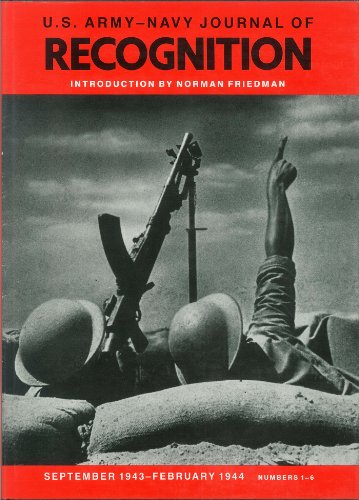
U.S. Army - Navy Journal of Recognition by Norman Friedman. hardcover edition. ISBN: 9781853102363.
First a couple of corrections to this listing. The introduction is written by Norman Friedman, not Griedman. Secondly, it is published by the Naval Institute Press in Annapolis, Maryland not "Life" magazine, although many of the photographs were taken by the staff of "Life." This book consists of journals 1 through 6 (out of a total of 24) which were originally issued in September 1943 - February 1944 and were intended primarily for (in fact, restricted to) readers in the United States Armed Forces. According to Norman Friedman, "it is a great introduction to the much more detailed literature on the technology of World War II ships, aircraft, and armored vehicles." I would think that the literature doesnt get much more detailed than this. Black-and-white photographs and diagrams are to be found in multiples on every page of this 9.5 x 13 inch hardbound reprint. The very first page of journal #1 has a quiz called the "All-in Raid" where the reader is invited to identify the silhouettes of 62 planes that are about to fly right over his head ("For answers see p.50.") The very first article, "No Margin for Error" concerns the vital need to be able to recognize vehicles of war (planes, tanks, ships, etc.) from any angle. Then we turn the page and are instructed on the identification of Britains "newest transport," the RAFs York (along with five photographs that show the difference between the York, its parent Lancaster, and the older Manchester). Most of the articles are two pages long, including the photographs, diagrams, cutaway drawings, etc. A bit of history, e.g. "Sherman was best in North Africa" is also crammed onto each page of text, and many of the photographs were taken in actual combat. Some WWII trivia is also included, such as a photograph of the medal that was presented to a Kingfisher scout-plane pilot who dropped his depth charges on what proved to be whale, not an enemy submarine. This is a fascinating book. Read it and you too will be the only person on your ship who can spot the difference between the silhouette of an Admiral Hipper class heavy cruiser and its very close cousin, the Prinz Eugen class heavy cruiser (answer: "a more broken aft section" on the latter.)